John Quincy Adams Quotes
I hold the resolution to be a direct violation of the constitution, the rules of this house and the rights of my constituents. It is for the sacredness of the right to petition that I have adopted this course. Blessed, forever blessed, be the name of God.
In 1836 the House of Representatives adopted the so-called "Gag Rule" whereby the house could not act on all further petitions regarding slavery, even though thousands of petitions were being received. Adams was one of the few who protested the Gag Rule:. Adams even submitted petitions with which he did not agree:. Every year Adams attempted to get the Gag Rule repealed. He was even threatened with censure for his efforts, but his status as an ex-president protected him. Finally, in 1844, Adams' perennial resolution carried:
John Quincy Adams, 1767-1848, 6th President of the United States (Independent, MA), Statements in Congress, 1844
Sourced by: Eigen's Political and Historical Quotations

There was a well orchestrated Congressional effort to pass a Constitutional Amendment to prohibit flag burning. There had been no recent incident of flag burning and there had been little or no flag burning for decades since the Vietnam War. Yet a small group of Congressmen had managed to get the issue onto the American national political agenda by skillful manipulation of the media and excellent PR.


The Nazis were banned from demonstrating in the streets of Skokie, Illinois on the grounds that they would incite violence. However, Goldberger of the ACLU took their case and won their right to spew their hatred before the Supreme Court.


This is probably the first known use of the Bill of Rights phrase in the English language. For the earliest American use, see Edward Rutledge.


The major phrase was first used in a dissent by Justice Robert Houghwout Jackson in 1949 {633526} and later by Chief Justice Earl Warren {601702}


Arguing for a Bill of Rights to assuage public objections to the original Constitution:
Striking down a law making cross burning a crime:

In 1974 the Senate Foreign Relations Committee was investigating the wiretapping of American citizens. An FBI witness, Bernard Wells, testified that the wiretaps had demonstrated no disloyalty but they had identified some "loose talk:"


On the Fugitive Slave Act: As one of the leading American Catholic intellectuals during the 19th Century, Brownson’s opinions went far in keeping Catholics from joining the side of the abolitionists. However, just a few years later his tone would change and he would become one of the few Catholic writers to refuse to defend slavery, see {610710}. While the majority of Catholics refused to join the abolition movement, they often did so because abolitionism was closely tied to anti-Catholicism, see Gordon {611392} or Shaftesbury {611106}. Other reasons included Irish immigrants fearful of competition from Black labor and the fear of liberal individualism and social disorder, which was prevalent in 19th century Catholic thought. For a further explanation on the relationship between American Catholics and slavery, see McGreevy {612036}.
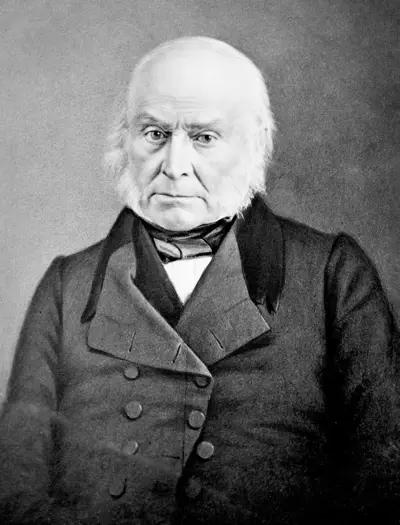
John Quincy Adams was an American statesman, diplomat, lawyer, and diarist who served as the sixth president of the United States, from 1825 to 1829. He previously served as the eighth United States Secretary of State from 1817 to 1825. During his long diplomatic and political career, Adams also served as an ambassador, and as a member of the United States Senate and House of Representatives representing Massachusetts. He was the eldest son of John Adams, who served as the second U.S. president from 1797 to 1801, and First Lady Abigail Adams. Initially a Federalist like his father, he won election to the presidency as a member of the Democratic-Republican Party, and in the mid-1830s became affiliated with the Whig Party.
