John Stuart Mill Quotes
I, having no legal means of divesting myself of these odious powers put on record a formal protest against the existing law of marriage.
the legal power automatically then given to a husband over his wife’s body and property
John Stuart Mill, 1806-1873, Member of Parliament, British Political Economist, Document signed upon his marriage to philosopher Harriet Taylor in 1851
Sourced by: Eigen's Political and Historical Quotations


This relatively radical viewpoint regarding equal rights for women was expressed by Roosevelt as his Senior thesis at Harvard in 1880. In those days, the kind of scrutiny of everything a candidate ever wrote or said that is characteristic of modern politics, did not exist. It is very doubtful that if the Republican Party officials had ever known that he had espoused these views—even as a young student, that he ever would have risen so high in the party, much less get nominated at the Vice Presidential candidate which was his entree to the Presidency. When in office however, there is no record of him reviving his youthful proposal that women who marry retain their maiden names.
The deed was made out in the name of her husband followed by the phrase “et ux”. That is a legal abbreviation for “et uxor” which literally means “and wife”. It was in use in English and American law from the time that married women had no right to property and the wife was a mere appendage to the husband. It is still recognized as a proper form by the law of many states.

The law at that time gave a married woman almost no rights. The husband legally controlled the family assets regardless of who had earned or provided them. He aslo had absolute control of the upbringing of the children. Women could not vote and in many states were considered property of the husband.


Billinghurst was physically handicapped without the use of her legs. She protested and marched in protest parades using a hand propelled tricycle which the police sometimes dumped her out of and left her immobile in alleys.

In English law, the second a woman married, she ceased to exist and an entity independent from her husband who had total control in the family. This doctrine was carried over to American law. See {629246}.


Although she was very outspoken about the plight of women in society, she was very disapproving of women insisting upon rights. See {585321}.
This technique she describes is consistent with Sharia—Islamic Law. It however is used by very few women who are sophisticated and courageous enough to do so.

At the time, in many states married women could not control their own inheritance, could not sign a contract, owned no part of a family business that a women might have founded and worked in her entire life, could not be an executor of a will—even if it were her husband’s.

This letter was written at the request of Rotrou the Archbishop of Rouen with the urging of King Henry II. Eleanor, one of the wealthiest and powerful people in Europe of either sex, left her husband and sided with one of their sons in a feud with the father, King Henry. Henry and most of the English and French courts wanted her to return to her husband and this letter was meant to chastise her behavior. She however, paid it no heed. The law of scripture to which Peter referred is a passage in the Book of Ephesians—see {618995}

Although born and educated in the United States, she lived mostly in England and was politically active there.


The decision was unanimous. Virginia’s racist slave era tradition used the power of the state to forbid interracial marriage for the purpose of maintaining white supremacy. Most of the Southern, formerly slave, states had such laws. The most absurd aspect of the anti miscegenation laws was that all whites and Blacks—and other so caltcled “races” all emanated from the same African human female who was Black.

See {628477} for the Dean’s answer. Professor Brooks was about to be married and under the mores of the day and Barnard’s rules, married women were not allowed to work. They should be at home taking care of husband and children. Ironically, there are still a few conservatives who advocate a return to the old policy.
See {628476} for the text that triggered this response. These quotations are very important because it illustrates the terrible sexism that existed even when women were hired into professional jobs which itself is rare. They should be at home taking care of husband and children. Ironically, there are still a few conservatives who advocate a return to the old policy.


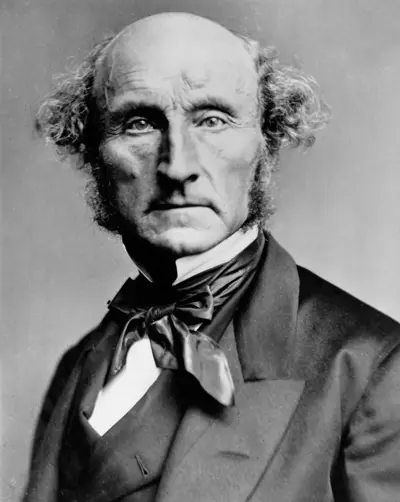
John Stuart Mill, usually cited as J. S. Mill, was an English philosopher, political economist, Member of Parliament, and civil servant. One of the most influential thinkers in the history of classical liberalism, he contributed widely to social theory, political theory, and political economy. Dubbed "the most influential English-speaking philosopher of the nineteenth century", he conceived of liberty as justifying the freedom of the individual in opposition to unlimited state and social control.
