Francis Galton Quotes
I have no patience with the hypothesis occasionally expressed, and often implied, especially in tales written to teach children to be good, that babies are born pretty much alike, and that the sole agencies in creating differences between boy and boy, and man and man, are steady application and moral effort. It is in the most unqualified manner that I object to pretensions of natural equality. The experiences of the nursery, the school, the University, and of professional careers, are a chain of proofs to the contrary.
There were some people at the time who believed that by means of effort and following moral precepts there would be an equality of achievement. There were also many who began to observe that much of the differences between individuals were are result of environment—opportunity for education, socialization and other factors. Science is still trying to determine the relative causal contributions to individual differences of genetics and environment.
Francis Galton, 1822-1911, English Scientist & Mathematician, Hereditary Genius, 1869
Sourced by: Eigen's Political and Historical Quotations


This quotation is important for two reasons. First, it appears to be the first use of the nature-nurture words to discuss this concept. Second, this “conclusion” started one of the longest running scientific debates in biology—nurture vs nature.


She was one of Francis Galton’s collaborators in his laboratory. This particular quotation if true challenges some of the basic aspects of democracy itself. However, it was a large part of the basis for the Eugenics movement, and is still argued by some today.
There were a substantial proportion of Americans who believed that mulattoes were per se inferior.


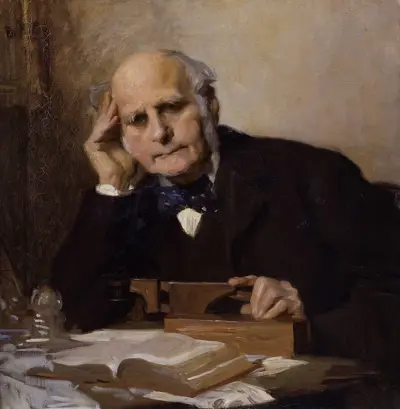
Sir Francis Galton, FRS, was an English Victorian era polymath: a statistician, sociologist, psychologist, anthropologist, tropical explorer, geographer, inventor, meteorologist, proto-geneticist, psychometrician and a proponent of social Darwinism, eugenics and scientific racism. He was knighted in 1909.
