Emmanuel Joseph Sieyes Quotes
I have brought you 100 million of these!
Emmanuel Joseph Sieyes, 1748–1836, French Roman Catholic Abbé & Clergyman, Revolutionary political writer and diplomat., Statement when he threw a fistful of Dutch Guilders on the conference table of the French Revolutionary Committee of Public Safety, 1795, [He had been the chief negotiator for the French with the Treaty of the Hague with Holland. France had sent a small army, headed by a French General who had been a Dutch Patriot, into Holland to support the Dutch revolution against the monarch William V, Prince of Orange. However, after the successful revolution the French wanted money from the Dutch to pay for the expenses of the supporting army. Abbe Sieyes negotiated the amount with the Dutch. Like the American Revolution in the Dutch Revolution the wealthy men of the country were on both sides. Unlike America however, the Dutch Revolution lasted only 6 days so the wealthy patriots had not exhausted most of their fortunes—hardly any because the fighting was so short {86230}. So the rich Hollanders still had most of their money and were grateful that they did not have to spend much as the French Army had really shortened the struggle. So they came up with 100 million guilders—an enormous sum of money—more than any of the members of the French Committee thought would be possible. It was a triumph for Sieyes personally in France.
Sourced by: Eigen's Political and Historical Quotations

“The enemy were the Dutch revolutionists and the French who had sent a small army to assist the Dutch rebels. The Count had his Castle right near the border of Holland in the Austrian controlled part of the Netherlands.


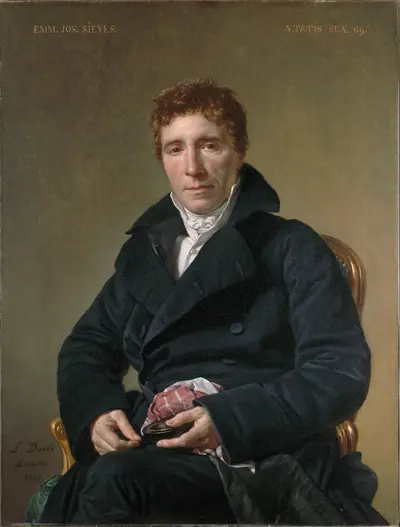
Emmanuel-Joseph Sieyès, usually known as the Abbé Sieyès (French: [sjejɛs]), was a French Roman Catholic Abbé, clergyman, and political writer who was a chief political theorist of the French Revolution (1789–1799); he also held offices in the governments of the French Consulate (1799–1804) and the First French Empire (1804–1815). His pamphlet What Is the Third Estate? (1789) became the political manifesto of the Revolution, which facilitated transforming the Estates-General into the National Assembly, in June 1789. He was offered and refused an office in the French Directory (1795–1799). After becoming a director in 1799, Sieyès was among the instigators of the Coup of 18 Brumaire (9 November), which installed Napoleon Bonaparte to power. Moreover, apart from his political life, Sieyès coined the term "sociologie", and contributed to the nascent social sciences.
