Samuel Johnson Quotes
I have always said, the first Whig [Liberal] was the Devil.
Samuel Johnson, 1709-1784, English Writer & Lexicographer, Boswell's The Life of Samuel Johnson, LL.d. April 28, 1778
Sourced by: Eigen's Political and Historical Quotations


What if you are a conservative in a liberal environment? Then what you are conserving is liberalism.
His reference was to his experience as an undergraduate at Dartmouth, which he and associates views as a liberal organization, while others viewed it as a conservative bastion of the establishment.


After JFK’s assassination, many of his appointees who were liberal Democrats, were concerned that LBJ was a Southern conservative and might not want to serve in a conservative administration. Johnson satisfied Heller and all of the other Kennedy appointees who he asked to stay on. Actually, Johnson was more liberal than JFK, and proved it during his Presidency.

Actually, it was the Tea Party members of the Republican Party whose unprecedented willingness to risk the full faith and credit of the United States when the majority of the Republican legislators and almost all the Democrats were not, who held the required Debt Ceiling Increase hostage to getting their legislative way. But in this particular debate and legislation the Democrats gained nothing except that the anger of the American People was much greater against the Republicans than the Democrats, many of whose usual supporters thought that the Democrats had been totally intimidated by the Tea Party.

So far as he was concerned, Republican moderates—his own party members—were liberals. Anyone who did not support the extreme Conservative agenda, was an enemy and a liberal. He and the Tea Party drove almost all the moderate Republicans out of the party.


Actually, there have been “paranoid” fear of opposition political viewpoints in America very often. In the early days of the Republic, the Federalists main concern was not England or other foreign enemies, but Jefferson’s Democratic Republicans. And those Jeffersonians were absolutely convinced that the greatest danger to America was the Federalists who would bring back a monarchy if they could. The Jacksonians triggered a similar polarization. The Civil War stemmed from this extreme. Even America’s most popular President, Franklin Delano Roosevelt, who was elected to 4 successive terms, was perceived as the major “enemy” of America along with his wife Eleanor and the other New Dealers.

The liberals of the Republican party had been the powerful and often dominant wing of the party since Theodore Roosevelt had instituted his reformism. Rockefeller was trying to maintain its preeminence inside the party against the then new Republican extremists led by Barry Goldwater. He lost at the convention, as Goldwater was nominated as the Presidential candidate. He was trounced in the general election because of his extreme form of Conservatism. However, while the extreme right wingers lost the election, they had won control of the Republican Party that defined Republicanism for decades thereafter as a conservative movement. They would make “liberalism” a dirty word, and the party did not concern itself with human need much thereafter while fighting the change and globalization that was beginning.

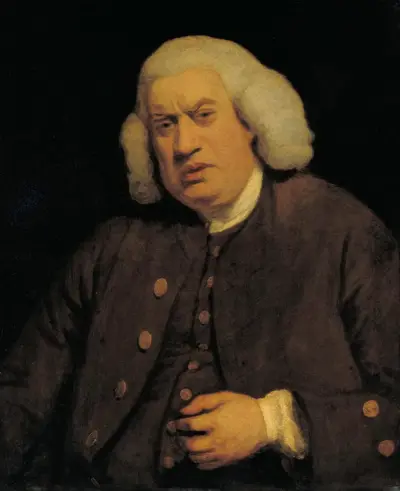
Samuel Johnson, often referred to as Dr Johnson, was an English writer who made lasting contributions to English literature as a poet, playwright, essayist, moralist, literary critic, biographer, editor, and lexicographer. Religiously, he was a devout Anglican, and politically a committed Tory. The Oxford Dictionary of National Biography describes Johnson as "arguably the most distinguished man of letters in English history". He is the subject of James Boswell's The Life of Samuel Johnson, described by Walter Jackson Bate as "the most famous single work of biographical art in the whole of literature".
