Gilbert K. Chesterton Quotes
I do not know much about Mohammed or Mohammedanism. I do not take the Koran to bed with me every night. But, if I did on some one particular night, there is one sense at least in which I know what I should not find there. I apprehend that I should not find the work abounding in strong encouragements to the worship of idols; that the praises of polytheism would not be loudly sung; that the character of Mohammed would not be subjected to anything resembling hatred and derision; and that the great modern doctrine of the unimportance of religion would not be needlessly emphasised.
Chesterton, G. K. All Things Considered. Methuen & Co., 1908.


This is a common perception of many Islamic authorities—that the ancient Jews and early Christians would have clearly become Muslims had they but been exposed to the teaching of the Prophet. As egocentric as this sounds, Martin Luther believed that all reasonable Jews would become Christians.

This is another of De Tocqueville’s prescient statements that in retrospect seem so amazing given the time. This quotation could serve as an op ed in a newspaper of any of the industrial democracies of the early 21st century. However, he did not have the information of the details we have today that showed Islam as the pinnacle of scientific, philosophical, literary and medical achievement at the beginning of the second millennium, while the Christian nations of Europe were mired in the Dark Ages. It was the same Koran but a very different interpretation and framework that led to the decadence while it was the Protestant Reformation that triggered a Christianity that was hospitable to modernity and enlightenment.


Amr ibn Al-'Aas was one of the companions of the Prophet Muhammad. In 2005 an Egyptian writer, Usama Anwar Ukasha, criticized the companion’s role for causing dissention and divisiveness in Islamic history. Some called for his legal punishment for slandering a holy figure and a law case was brought to force him to divorce his wife—so that she would not be “contaminated” by his heretical thoughts. Some Egyptians argued that anyone should have the right to analyze and criticize the role of any historical figure—except for The Prophet (see {585045})—but Dr. Shahin explained that under Islamic Law (Sharia) such criticism may not be permitted and the state should punish the offender.
In an orthodox Muslim nation, freedom of speech as a right is impossible.


This is often referred to as the “prophetic mission.” This line appears on most Muslim coins and some monuments.
The people of the Book refers to Jews and Muslims. This passage of the Koran is used to justify ecumenism with Muslims integrated with Jews and Christians. The Koran consists of Muhammed’s sayings, and he himself had opinions about Jews and Christians that differed from time to time. So although this passage signals a tolerant religion, in other places Muhammed preached violence against the people of the Book. At first Muhammed and his followers expected to see the people of the Book adopt Islam as their religion. When they did not, relations deteriorated somewhat.
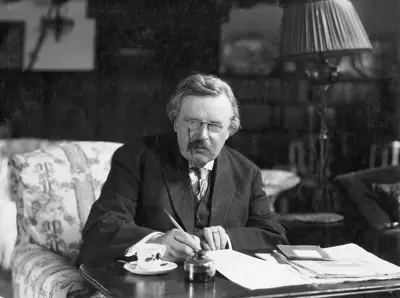
Gilbert Keith Chesterton KC*SG was an English writer, philosopher, lay theologian, and literary and art critic. He has been referred to as the "prince of paradox". Time magazine observed of his writing style: "Whenever possible Chesterton made his points with popular sayings, proverbs, allegories—first carefully turning them inside out."
