Rosa Parks Quotes
I did not get on the bus to get arrested I got on the bus to go home.
The South was segregated at the time and Negroes were required by law to sit in the back of the busses. There were no seats left in the back and Ms. Parks sat in the “white” section causing her to be arrested. That act ignited public opinion, led to Black boycotts of segregated busses, and morphed into the civil rights movement.
Rosa Parks, 1913-2005, Civil Rights Protester & Leader, Quoted in Rita Dove, "Rosa Parks: Her simple act of protest galvanized America's civil rights revolution," Time, June 14, 1999
Sourced by: Eigen's Political and Historical Quotations


In the early 1950s, most of the South was racially segregated. Though hard to believe today, the Alabama law then required a Black man or woman to sit in the back of the bus. Rosa Parks, a black woman, sat in a seat in the middle of the bus and refused to give up her seat to a white man. She just quietly sat in her seat. She was arrested, and this triggered the Montgomery Bus Boycott of 1955 which was a major event in the Civil Rights struggle. Alabama was not the only state where this type of outrage occurred. The South at that time was relatively backward educationally, commercially, and legally and racial segregation was a huge problem in most of the South.


Freedom Rides were interracial groups of Civil Rights advocates who boarded public interstate busses in Washington and rode South through some of the most segregated communities in the country. As the bus stopped at the segregated rest stops, the Black Freedom Riders would use the “white” waiting rooms, toilets, and other facilities which was against the local custom and law. Racist segregationists often brutalized and assaulted the Freedom riders whose leaders demanded Federal Protection. The Attorney General and others were trying to get the local politicians and law enforcement officials to protect the Freedom Riders, but often these were the worst of the racist segregationists. Kennedy thought if he could have a “cooling off period” for a few days, he could persuade the locals to protect the Freedom Riders from the mobs with the threat of sending Federal Marshalls or troops for the protection. So he asked Farmer and other Freedom Ride organizers to stop the Freedom Rides for a few days. This was Farmer’s famous response. The Freedom Rides continued and forced the Federal Government to respond on a timetable they did not prefer.


His strategy was to fill the jails of Birmingham, and asked the young people to help. The next days saw virtually all the Birmingham high school students our of school and in the streets protesting which was then against the un-Constitutional laws of Birmingham and Alabama. The students were arrested by the droves and the white authorities, believing that they were being firm against “radical lawbreakers”, fell into the trap, and became a travesty to most of the country and the rest of the world and the hundreds of jailed students beaten and assaulted raised the consciousness of whites as well as Blacks.

In November of each year protesters gather at Fort Benning, the site of the U. S. Army School of the Americas. The School provides training for Latin American Military Officers in Counter-Insurgency Training. The graduates of the school have included some of the worst Latin American killers and torturers (See {41061} for example) who rose to positions of power in their lands. It has also included many leaders who did not ever resort to war crimes and atrocities and also became leaders of their countries. It has been an institution of great controversy since it was discovered that the school at one point taught methods of interrogating insurgents that were tantamount to torture. Defenders of the school claim that but for the school, the military atrocities would have been worse and that it contributed to more human and democratic governments in the Americas. The annual protest has attracted more than 16,000 protesters, some of whom—like Bourgeois—have been guilty of trespass and interfering with a government facility and have served jail terms for those violations.

Refusing induction into the armed forces during the Vietnam War:

Defending his action of using national guard troops to prevent school integration:


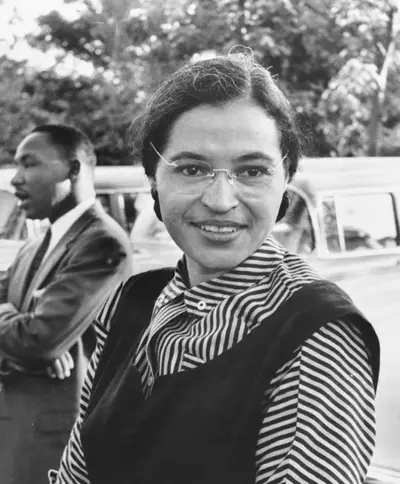
Rosa Louise McCauley Parks was an American activist in the civil rights movement best known for her pivotal role in the Montgomery bus boycott. The United States Congress has called her "the first lady of civil rights" and "the mother of the freedom movement".
