John McCain Quotes
I cannot in good conscience vote in favor of tax cuts, irrespective of their size, or to which segment of the population they are targeted. Nor can I support any spending increases that are not related to improving our nation's defense from the obvious and serious threats facing us today.
McCain, John. Statement on the 2001 Tax Relief Act. Congressional Record, U.S. Government Printing Office, 26 May 2001.


Kennedy, with great Republican support proposed a reduction of the top income tax rate from 91% to 65%, reduction of the bottom rate from 20% to 14%, and a reduction in the corporate tax rate from 52% to 47%. That put the tax rates at the appropriate level. Economic growth was reasonable until President Reagan’s military spending cold war strategy produced huge deficits, Clinton raised the tax rates slightly and had the best economic growth ever, and had a balanced budget. George W. Bush lowered taxes had much slower growth and even larger deficits. However, by 2013 all hints of bipartisanship were gone. The Republicans claimed that the then tax rates were much too high—the highest income tax was half the rate that most agreed in 1962 was the right rate. And the corporate tax was 35 %, far lower than the Kennedy rate of 47% and incredibly lower when we consider that with deductions that were then in force the average corporate tax was only 12% the lowest since the Great Depression. Meanwhile the 2008 Bush Economic Meltdown and the Great Recession it produced the highest deficits in history with the lowest taxes in modern times and much of the polarized population demanding further tax cuts and an equal number demanding increased tax revenue.


Jefferson was opposed to a standing army or a buildup of revenue even in case of war. He thought that a national surplus might tempt an administration to engage in war. This was one of the biggest differences between the Jeffersonians or Republican Democrats as they called themselves and the Federalists led by George Washington and John Adams. Washington was a strong advocate of military preparedness, while Jefferson believed that a nation which had a strong army and war chest would be too easily tempted to use it. That debate has raged in America since. However, at the beginning of the second world war, the then conservative party, the Republicans, had adopted the Jeffersonian view and it was FDR and the Democrats arguing for armament and preparedness. The United States was terribly unprepared for war, but mobilized rapidly and won the day. Since then both parties have supported military preparedness and the political argument has been over the degree, but there are few Jeffersonians left when it comes to military preparedness.


See {619116}. for a related idea of his.

The Laffer curve was a mathematical, economic curve supposedly showing the relationship between tax rate and government revenue from taxes. In Laffer’s version of this curve, as interest rates go down, revenue from taxes goes UP because according to Laffer, there will be much more economic activity if taxes are lowered. In reality this has happened rarely in certain countries and in a very narrow range of tax deduction. As Chretien observes if you lower the tax rate to zero according to the Laffer curve this should maximize revenue but obviously it does not because with a zero rate there are no taxes collected even if the economy is booming. The Laffer curve was ideologically popular with those politicians wanting to lower taxes, but it never stood up to serious analysis and never worked in practice as Chretien observes. As a result, some people refer to the curve as the Laughter curve.


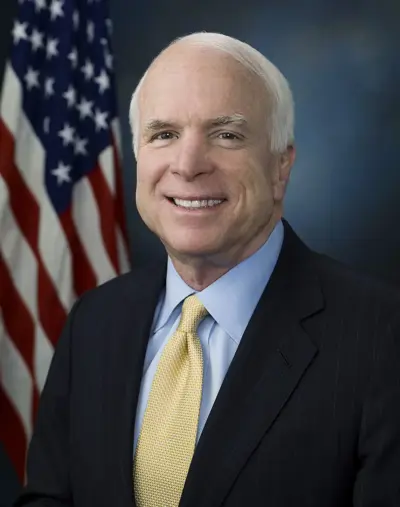
John Sidney McCain III was an American politician, statesman and United States Navy officer who served as a United States Senator for Arizona from 1987 until his death in 2018. He previously served two terms in the United States House of Representatives and was the Republican nominee for president of the United States in the 2008 election, which he lost to Barack Obama.
