Eleanor Roosevelt Quotes
I cannot however say that in European countries the control by the Roman Catholic Church of great areas of land has always led to happiness for the people of those countries.
The Catholic Church was allied with the Fascists in Spain in the 1930’s. In the Spanish Civil War many Americans supported democracy and the Republicans. Historically in these days the Church had been associated with the power establishment and when there was a revolution as in Mexico, the Church was seen to have been part of the problem and its assets were nationalized and its influence diminished. Spellman and the Vatican were worried about the same thing in Spain and hence allied themselves with Franco, Hitler and Mussolini. As a result of backing the wrong side morally at that time, the Church after WWII became a leader in advocating freedom and democracy in many parts of the world, but still had historical ties to the right wing elements of a new nations in South America.
Eleanor Roosevelt, 1884-1962, First Lady (Franklin Delano Roosevelt), U. S. Delegate to the United Nations, Statement to Cardinal Spellman
Sourced by: Eigen's Political and Historical Quotations


Lowery was one of the senior Black leaders in the civil rights movement of the late 1950s and early 1960s. In this interview, he was describing the atmosphere in Mobile, Alabama. Clergy of most faiths were active in the Civil Rights Movement in the South with the exception of the Roman Catholic Church which was very institutionally conservative. The Catholic leaders had a problem in that Catholics had been heavily discriminated against in early America and this prejudice was heaviest in the South in the 20th century. They feared that Catholic Activism against the status quo would create more problems for Catholics so they were not very helpful or supportive. This was NOT true for Catholics in general. Many individual Roman Catholics marched in the demonstrations, and some Catholic clergy from outside of the South came to the Southern protests and demonstrations. In the 20th century, the Catholic Church was divided between social activist reformers and in some cases revolutionists and the conservative wing of the Church who had supported the status quo.


Coughlin was a great admirer of Adolf Hitler and Benito Mussolini and the Fascists. He was one of the American “heroes” in Nazi Germany, receiving assistance from the Nazi government. Between his anti-Semitism and support for Hitler, Fascism and radical socialism, the Vatican ordered him off the air and shut down his political demagoguery.


The Roman Catholic Church then maintained that salvation was dependent upon obedience to the Pope in all things civil and religious. See {595166} for the way that the Church at the time allowed some authority to civil authorities.

The Roman Catholic Church hierarchy had just cracked down on some nuns and their orders who were discussing and debating classic church positions, like male only priesthood, birth control, women’s roles in the society and in the search. There were many strongly worded admonishments from the Vatican. Down found it odd that the Church Fathers should be so distressed by activist nuns when their reaction to Priest sexual predation of young boys was by comparison, so mild.

Two were executed and the others sent to the Gulags. This is often quoted to show how hostile the Soviet Union was to all religions.


While this is very true in the long term, the Church in the short term has almost always supported actively or by its neutrality, the ruling class as opposed to those who would make revolutionary change even to the extent of participating in the torture, murder, and intimidation of most of the Catholics in the society. The ruling class, in turn, supported the Church and used the power of the state to enforce religious doctrine and prevent alternative religious views and practices to prevail even if only with small minorities. See {632407} for another Mises quotation articulating examples of this.

Naples was an independent kingdom before the unification of Italy. This quotation illustrates one of the lowest periods of the Roman Catholic Church where the personal morality of the Pope and Cardinals was greatly at odds with the earlier and current positions of the Church. This hypocrisy, nepotism, and corruption was one of the major factors that led to the Reformation. Note that the Pope had an illegitimate son who he named a Cardinal and the Pope wanted his son to marry the daughter of the king. The king was not enthusiastic given the son’s status as a Cardinal of the Church.


Hoover was an inveterate racist and had an extreme hatred of King. A month later King was awarded the Nobel Peace Prize. What was not known at the time was Hoover, although it had nothing to do with law enforcement, actually contacted New York Cardinal Spellman and illegally transmitted to him parts of FBI confidential and secret files on King for the purpose of persuading the Pope not to grant King an audience. Nonetheless, Hoover himself had a behind the scenes reputation of leaking for his personal purposes and that much of the contents of many FBI files were notes on unsubstantiated claims made by political enemies and often far from the truth. The Cardinal, the Pope and their staffs chose to ignore the Hoover materials.

This quotation shows the unique relationship that the Irish Republic has had with the Catholic Church. There was probably no other non Muslim country in the world where a political leaders could get elected avowing this kind of loyalty and control by a religious heirerchy. See {639726} for an even more Irish, drastic departure from the concept of separation of church and state.


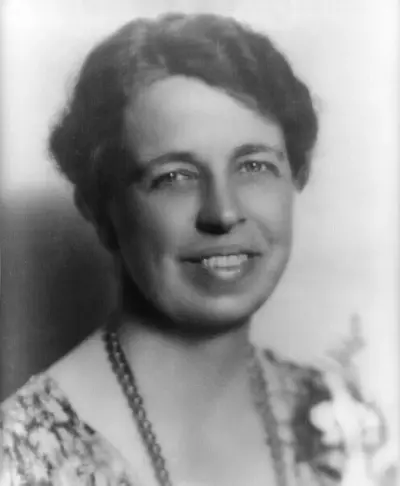
Anna Eleanor Roosevelt was an American political figure, diplomat and activist. She served as the First Lady of the United States from March 4, 1933, to April 12, 1945, during her husband President Franklin D. Roosevelt's four terms in office, making her the longest-serving First Lady of the United States. Roosevelt served as United States Delegate to the United Nations General Assembly from 1945 to 1952. President Harry S. Truman later called her the "First Lady of the World" in tribute to her human rights achievements.
