Eduard Shevardnadze Quotes
I believe that with the help of foreign countries - and under that condition only, because they have no other source of financing - the new government may temporarily extricate Georgia from the current situation.
Shevardnadze, Eduard. Interview. BBC Monitoring Former Soviet Union, BBC, 25 Nov. 2003.


Precursor to CIA. WWII had begun in Europe and England was under great pressure as Hitler threatened invasion and the German military had been successful everywhere they tried to invade. FDR had received an intelligence report and advice from our Ambassador to England, Joseph P. Kennedy (JFK’s father). He told the military, the State Department, and the President that England was finished—that they would not be able to stave off the coming German invasion. He predicted that Germany would set up a puppet state. Any help America could supply would not only be wasted but if material, would fall into the hands of the Nazis and be used against us. {610109} The military attaches attached to our Embassy in England generally agreed. However, the President knew that not only did Kennedy dislike Winston Churchill {613151}, but he had been an admirer not only of German Fascism, but Hitler in particular. Kennedy ran around with some of the wealthy, aristocratic English Fascists who were advocating a negotiated surrender to prevent English civilian casualties. So FDR sent his friend, Donavan, to make an independent Assessment. Donovan had served as an officer in WWI and had earned the Medal of Honor. This quotation was the summary of Donovan’s recommendation. Based on Donovan’s report, and other information, the president had gathered and his geopolitical judgment, FDR provided aid to England (Lend Lease) and fired Kennedy, who had disliked Roosevelt before and this turned to hate and became a vendetta for Kennedy thereafter, especially when his oldest son Joe volunteered to serve in the war, that the Ambassador had so viciously opposed, {610121} and then was killed while carrying out a very dangerous volunteer mission. {616651}.


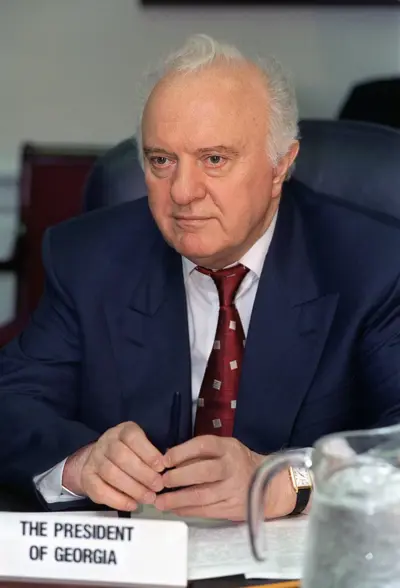
Eduard Ambrosiyevich Shevardnadze was a Georgian politician and diplomat. He served as First Secretary of the Georgian Communist Party (GPC), the de facto leader of Soviet Georgia from 1972 to 1985 and as Minister of Foreign Affairs of the Soviet Union from 1985 to 1991. Shevardnadze was responsible for many key decisions in Soviet foreign policy during the Gorbachev Era including reunification of Germany. Following the dissolution of the Soviet Union, he was President of Georgia (or in equivalent posts) from 1992 to 2003. He was forced to retire in 2003 as a consequence of the bloodless Rose Revolution.
