Antonio Lopez de Santa Anna Quotes
I beheld absolutism in all its power; and I felt encouraged to enter into a struggle against Augustin I.
Antonio Lopez de Santa Anna, 1795-1876, President of Mexico and Commanding Mexican General, Description of Mexican Emperor Agustin I by the then young officer, Santa Anna, Quoted in Robert Harvey, Liberators
Sourced by: Eigen's Political and Historical Quotations

Iturbide, known also as Agustin I, was the first Emperor of Mexico who was executed by a firing squad.


Porfirio Diaz - the longtime dictator of Mexico stole the election of 1910 and had his opponent Francisco Madero arrested and imprisoned. Madero got out, crossed the border to San Antonio, and issued this declaration which started the Mexican Revolution. See {613620} for the statement that declared the Revolution.


In 1775 Brown University decided to forgo the usual public Commencement and celebration due to:

Charles I had caused the death of his subjects with impunity and was called to account. However, the English Parliament did not know what specific crime the King had committed. Kings had executed people, guilty of crimes and otherwise, for centuries. For what could a king be accountable. Cooke developed the crime of Tyranny and drew up and presented the indictment for that. The King was found guilty and executed. This was the first time in legal history that a ruler was called to account for crimes committed against his own people. It became the foundation for many trials thereafter including that of Saddam Hussein in 2006.
Honore Gabriel Victor Requiti. The French King had just opened the French National Assembly which contained deputies (delegates) from the clergy, the nobility and the people. The King had made what some deputies thought was a very constructive and responsible speech opening the assembly. Mirabeau observed that as long as there was an absolute monarch in place, even a benign one. It was the presence of a monarch itself that was evil.


Part of the problem lies in a part of the Muslim religion which values stability over all else except Islam itself. Traditionally Muslims have been told to tolerate a bad, corrupt leader, unless he is blasphemous. So dictators who can create an alliance between themselves and the religious influentials by giving them money and allowing them to control civil society as in Saudi Arabia, have been insulated from rebellion and revolutionary forces.


Soon he had the power of a dictator but he didn’t force his will on the vast majority of the Cubans. His decrees made all the wealthy and the cronies of the dictator Batista outraged and most of them left Cuba. He was a dynamic demagogue and the people handed him dictatorial powers which he did not reject. He was so popular that he was the only leader in the Americas who would give 4 hour speeches and move through the streets without any bodyguards until the United States and dissident expatriates tried to assassinate him. With all that popularity, none the less he would not allow open criticism of his regime and jailed many political opponents. So he indeed became a dictator but never needed the machine gun to maintain power.

This quotation is a great demonstration of how much wiser and the better politician of all the crowned heads of Europe that Queen Victoria was. There were stirrings of freedom and desire for parliamentary government throughout Europe. Queen Victoria, even though and perhaps because she was a young woman, had a great feel for fairness and reasonableness and had read a great deal of history. There were some radical red socialists calling for complete radical revolution scaring European Royalty profoundly. They reacted very conservatively and with reaction, reverting to more tyrannical practices of the past urged in that path by very conservative, right wing advisors. Victoria also had little respect for some of the monarchs who had little interest in their people and much with their personal power and wealth. In the end, it was England which was the only nation which never had a serious radical socialist / communist threat, and that had much to do with Victoria’s political acumen and wisdom.

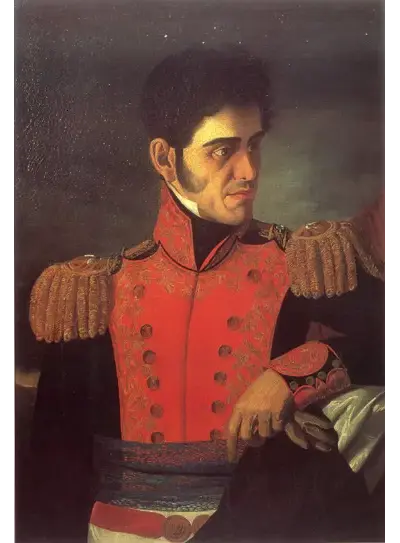
Antonio de Padua María Severino López de Santa Anna y Pérez de Lebrón, usually known as Santa Anna or López de Santa Anna, was a Mexican politician and general. His influence on post-independence Mexican politics and government in the first half of the nineteenth century is such that historians of Mexico often refer to it as the "Age of Santa Anna".
