James Connolly Quotes
However it may be for others, for us of the Citizen Army there is but one ideal - an Ireland ruled, and owned, by Irish men and women, sovereign and independent from the centre to the sea, and flying its own flag outward over all the oceans.
Connolly, James. "The Irish Flag." The Workers' Republic, 8 Apr. 1916.

He had been exiled to the United States.


He was elected to Parliament while in jail and never took his seat as he died as the result of a hunger strike in jail.


At the partition if India into Hindu and Muslim States, what is now Bangladesh, was a part of Pakistan called “East Pakistan” by the Pakistani government. While India became a thriving democracy, Pakistan with its combination of military strongmen and Islamic Fundamentalists did not fare as well and became a very corrupt, undemocratic military nation. East Pakistan was not contiguous with the rest of Pakistan and was culturally quite different and less religiously fundamentalist. While all Pakistanis suffered from poor government, the East Pakistanis fared worse. Finally, they developed their own identity which was suppressed by the military dictators of Pakistan and the Banglas revolted and Bangladesh became and independent nation.


The “Defenders” were the Catholic terrorists who along with their Protestant Orange Order counterpart were in sporadic acts of violence and terrorism with no military objective. The French Army was not to sail for Ireland where they would link up with The Defenders and take Ireland from the English. The invasion failed when terrible weather forced the French troop ships carrying more than 45,000 invading soldiers to cut their anchor cables and return to France.

“Esto perpetua” is Latin for “May it be forever”. Ireland had just obtained the right from England to pass their own laws in their own parliament. They were still under English control but now they were like a colony and not under day-to-day control.

He was addressing the Conservatives of Ulster, the Northern Ireland province that was the center of the Orangemen movement of Irish Protestants who were fighting to retain 'Protestant Ascendency' -- which was the social, political and cultural domination of the Protestants (the minority) over the Catholics (the majority). This was best achieved by keeping Ireland a part of Great Britain as opposed to having Ireland as a separate, independent country.

A delegation from Sinn Fein, headed by Arthur Griffith and Michael Collins, had negotiated a treaty of Irish Independence except that it did not cover Northern Ireland where the majority of the people wanted to stay a part of Britain. For 700 years, the Irish had fought for independence, and finally they got it for the vast majority of Ireland and the overwhelming majority of the Catholics of Ireland. The alternative to agreeing to the treaty was to continue the war between the IRA and the British Troops. At the time, the IRA was just about totally beaten and probably could not hold out another month. De Valera, a very shrewd politician, as the leader of Sinn Fein (and the IRA) would normally have headed the Irish Delegation. But he chose not to because he realized that they would never get independence for all 32 counties of Ireland as the British would not leave the Northern Ireland Protestants to their fates against their will. The best Ireland could get was Independence for all of Catholic majority Ireland. And he knew that public opinion would oppose giving up even one county becuse that was what the leaders had told the people for years. So De Valera let his two associates take the popular blame after he denounced the treaty with his famous quotation {639690}. Shortly after that, Michael Collins, the brilliant military Commander of the IRA who signed the treaty was assassinated. To many, it was as if De Valera had pulled the trigger. The treaty was ratified by a 7 vote margin by the Dail as there was no army left to fight, and the angry Irish electorate voted for De Valera as Ireland’s first President. The politician had won; the patriot had died.
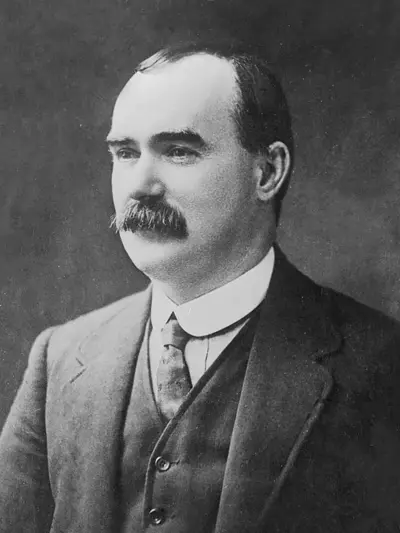
James Connolly was an Irish republican, socialist and trade union leader. Born in the Cowgate area of Edinburgh, Scotland, to Irish parents Connolly left school for working life at the age of 11, and became involved in socialist politics in the 1880s.
