Jeannette Rankin Quotes
How can people in other countries who are trying to grasp our plan of democracy avoid stumbling over our logic when we deny the first steps in democracy to our women?
Congressional Record, 65th Cong., 2nd sess., 10 Jan. 1918, p. 771.


Woodrow Wilson had just finished speaking to the convention – see {638532}. This statement was thought be some to be insulting to the President who said he favored the right of women to vote, but did very little if anything to make that happen. Although Shaw was an ordained Methodist Minister, the Methodist Episcopal Church refused to allow her to preach because of her suffrage views.


This was de facto Equal Rights legislation.


This remarkable statement was written in about 1840 and there was probably then few people of either gender who would think such a thing possible.

Stowe persuaded Lockwood to stand for President. They tried to recruit a man for the Vice Presidential nomination, and when they could not, Stowe became the first female to become a Vice Presidential candidate.


Mounting the scaffold referred to the scaffold for execution via the guillotine. If women could be executed she argued, women should be able to engage in public politics. Many women were executed in the frenzy and terror of the French Revolution. Ironically, the year after she wrote this, she herself mounted the scaffold and was beheaded by the state.

Hunt gave as an example Mary Smith of Stanmore. This quotation is very interesting in the history of women’s suffrage. Hunt was a strong advocate for Universal Suffrage (See {616653}.) At the time, even men had to be a taxpayer and own a sufficient amount of property to vote. Less than 20% of the population of Britain were allowed to vote. The argument at the time was that the husband would represent the family’s interest at the ballot box and there was no need for women to vote. But by facing parliament with the logical inconsistency of its position, he was able to make his point, although there were very few women like Mary Smith who were single and had the economic resources to qualify. Most widows remarried so even if they had economic resources, there was a man who could assume the then perceived role of head of the household.


She was the first presidential candidate's wife to admit such a radical position.
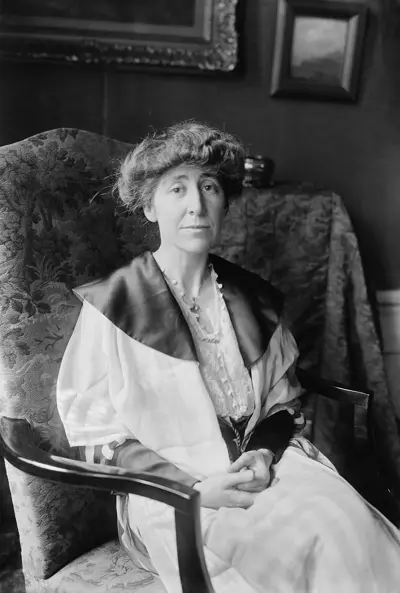
Jeannette Pickering Rankin was an American politician and women's rights advocate, and the first woman to hold federal office in the United States. She was elected to the U.S. House of Representatives as a Republican from Montana in 1916, and again in 1940.
