Frederick Douglass Quotes
Everybody has asked the question… “What shall we do with the Negro?” I have had but one answer from the beginning. Do nothing with us! Your doing with us has already played the mischief with us. Do nothing with us! If the apples will not remain on the tree of their own strength, if they are wormeaten at the core, if they are early ripe and disposed to fall, let them fall! I am not for tying or fastening them on the tree in any way, except by nature's plan, and if they will not stay there, let them fall. And if the Negro cannot stand on his own legs, let him fall also. All I ask is, give him a chance to stand on his own legs! Let him alone!
Frederick Douglasss, ~1817-1895, Abolitionist & Editor, Recorder of Deeds, District of Columbia, U. S. Minister to Haiti
Sourced by: Eigen's Political and Historical Quotations


Johnson had a white mistress who accompanied him visibly at a time when Blacks were lynched for dating white women in many parts of the country. He was criticized heavily by whites for going with a white woman and many Blacks for the same.

The editor at the time was Dr. William H. Boyle but no one is sure whether he, the owner, or someone else, wrote the editorial. The quotation illustrated a fascinating twist of logic that was very commonly held at the time. “If God created men of different colors, he must have meant them to be separate.” It is fascinating that virtually no one at the time made a similar argument about hair or eye color, intellect or other differential traits of people. Although this logical fallacy waned in the latter part of the 20th century, there are some who still hold to it.

The first sentence is inscribed on the Jefferson Memorial in Washington DC. The last two sentences are rarely quoted.


Before the civil rights act was passed, most labor unions will racist and discriminated against black workers. The United Auto Workers union was an exception and Reuther was a strong advocate of desegregation and equal rights.

First issue of the first Black Newspaper in America.
The Quakers were in the forefront of not only the abolition of slavery but of the integration of the races.

He was the only Black member of Congress at the time.


Having endured centuries of near slavery and discrimination, 70,000 Irish people signed this petition urging American-Irish immigrants to understand the similar plight of African-Americans and to join together with abolitionists. Irish immigrants were nevertheless reluctant to join the abolition movement because the movement was often tied to anti-Catholicism and many feared that the emancipation of Blacks would increase competition for the low-paying jobs immigrants held.


Throughout the Jim Crowe era of the South, the Southern whites were the poorest Americans with the exception of the Blacks, with few economic and cultural opportunities compared with the rest of the nation, the schools were the weakest of any area of the nation, the universities behind, and politically even whites had few choices with single party (Democratic Party) rule. While desegregation was fought tooth and nail by most white Southerners, it had the effect of elevating all phases of Southern life go that the gap between the South and the rest of the country diminished considerably. But the Blacks were also freed from the evil system and that was the “price” to the whites to which Baldwin referred.


At the time, the Southern segregationists were all Democrats and they blocked any Democratic attempt to pass any Civil Rights legislation. When he could not get a Civil Rights commitment from his own party, Powell turned to the Republicans and the President wrote this letter. In return, in November, Powell endorsed and supported Eisenhower instead of Stevenson, his own party’s nominee. Eisenhower could not get any legislation on Civil Rights as the Southern Democrats would always block it. When President Lyndon Johnson finally forced the 1963 Civil Rights Act through the Congress, the racist Southern Democrats cut a deal with Goldwater and the conservative Republicans, and switched parties. Since then the Civil Rights stance of the two parties reversed. The Democrats were thereafter pro Civil Rights and the Republicans, the party of Lincoln and Reconstruction, thereafter reversed their Civil Rights position and opposed progress in this area.
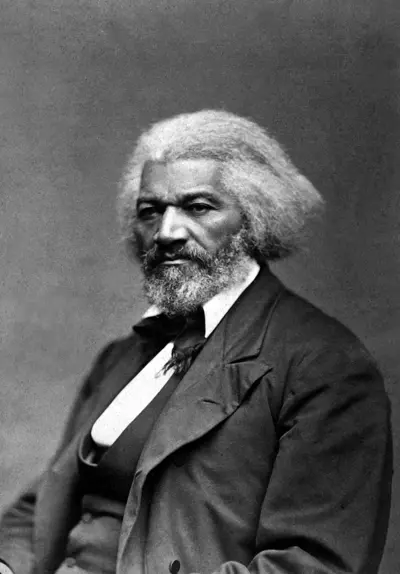
Frederick Douglass was an American social reformer, abolitionist, orator, writer, and statesman. After escaping from slavery in Maryland, he became a national leader of the abolitionist movement in Massachusetts and New York, becoming famous for his oratory and incisive antislavery writings. Accordingly, he was described by abolitionists in his time as a living counterexample to slaveholders' arguments that slaves lacked the intellectual capacity to function as independent American citizens. Likewise, Northerners at the time found it hard to believe that such a great orator had once been a slave.
