William Blackstone Quotes
Every wanton and causeless restraint of the will of the subject, whether practiced by a monarch, a nobility, or a popular assembly, is a degree of tyranny.
Blackstone, William. Commentaries on the Laws of England. Vol. 1, Clarendon Press, 1765, p. 122.


Charles I had caused the death of his subjects with impunity and was called to account. However, the English Parliament did not know what specific crime the King had committed. Kings had executed people, guilty of crimes and otherwise, for centuries. For what could a king be accountable. Cooke developed the crime of Tyranny and drew up and presented the indictment for that. The King was found guilty and executed. This was the first time in legal history that a ruler was called to account for crimes committed against his own people. It became the foundation for many trials thereafter including that of Saddam Hussein in 2006.


With so many revolutionary rulers of new nations suppressing all opposition, the history of Ataturk and Turkey is unique. Ataturk was so popular and his People’s Party so successful that there was no opposition and Turkey had one party rule. However, Ataturk was determined to have Turkey become a parliamentary democracy as good as the Western nations of Europe. So a tradition of multi-party democracy was needed. So Ataturk actually went to his friend Fethi Okyar and asked him to start an opposition party and oppose the government. Fethi was a strong supporter of the revolution and generally was in concurrence with Ataturk and the People’s Party on everything. Ataturk however convinced him that they had to start a tradition that would take Turkey through the future, and he did create a new party-- Serbest Cumhuriyet Fırkası (Liberal Republican Party) and worked hard to find differences with the People’s Party and the Government. One immediate contribution was the oversight that the new party provided—a strong tradition that exists to this day in Turkey.


This illustrated the problem with Nazi Germany where Hitler was elected by the people. In a Constitutional democracy such as the United States, when an elected President attempts to cut away constitutionally insured freedoms, there is public opinion, the press, a Congress and a Supreme Court to check him as occurred in the George W. Bush Administration over wiretapping, torture, and handing of war captives. These were checked, but they were minor and trivial compared to Nazi Germany’s abuse of freedom. In Germany, Hitler weakened or destroyed all those who might check his power and therein lies the essential difference. The despot must eliminate or weaken the checks on him. In the American democracy, the Congress finally checked John Adams’ Alien & Sedition Act as did public opinion by turning him out of office after one term. But in each case, in democracy or dictatorship, the same argument is often made if the elected leader impinges on some freedoms: it is legitimate because he represents the will of the people. Spencer and many others have always disagreed.

He was arguing that the government should be able to prohibit public demonstrations on the grounds that the protesters are “irresponsible power.” This position has been taken sometimes by the American right, and is common in all totalitarian states.

Originally it was published in Boston under the name “A Columbian Patriot.”


FDR was a marvelous judge of men and their character. De Gaulle could not separate himself from France and pushed the French Republic towards one man rule (himself) as much as anyone since Napoleon Bonaparte.
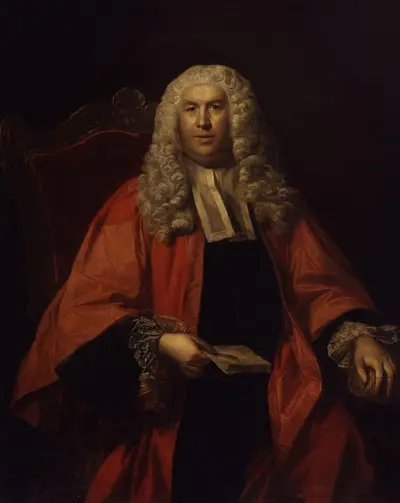
Sir William Blackstone SL KC was an English jurist, judge and Tory politician of the eighteenth century. He is most noted for writing the Commentaries on the Laws of England. Born into a middle-class family in London, Blackstone was educated at Charterhouse School before matriculating at Pembroke College, Oxford, in 1738. After switching to and completing a Bachelor of Civil Law degree, he was made a fellow of All Souls, Oxford, on 2 November 1743, admitted to Middle Temple, and called to the Bar there in 1746. Following a slow start to his career as a barrister, Blackstone became heavily involved in university administration, becoming accountant, treasurer and bursar on 28 November 1746 and Senior Bursar in 1750. Blackstone is considered responsible for completing the Codrington Library and Warton Building, and simplifying the complex accounting system used by the college. On 3 July 1753 he formally gave up his practice as a barrister and instead embarked on a series of lectures on English law, the first of their kind. These were massively successful, earning him a total of £453 (£71,000 in 2021 terms), and led to the publication of An Analysis of the Laws of England in 1756, which repeatedly sold out and was used to preface his later works.
