Richmond Enquirer Quotes
Democratic liberty exists solely because we have slaves ... freedom is not possible without slavery
This quotation illustrates the level of delusion regarding the importance of slavery that the plantation and slave owners had induced in Southern Society.
Richmond Enquirer, Editorial, 1856
Sourced by: Eigen's Political and Historical Quotations

He was making a generalization based on his historical study of nations and societies.

Referring to Black Congressman Julian Bond: Louis Eugene Walcott


This is a memorable historical quotations because it shows the extreme level of hypocrisy and lack of logic of which man is capable of when his way of life and world view is threatened. In this case Gordon sees the right to own slaves as a basic civil right. He does not see that the right of possessing slaves totally denies virtually all civil rights to the slave. In his and other Southern views, to assure a man’s liberty he had to have the right and freedom to deny freedom to others, torture others at will, destroy families and remove all hope and aspiration of some people.


Referring to the Arawak natives he found when he landed in the "new world—San Salvador:"


Canada was then still under British rule.


Brown was the richest man in Rhode Island and made much of his money in the slave trade. This quotation shows that slavery was not completely a North verses South split. Northerners like Brown for whose family Brown University was named, was as virulent supporter of slavery as the most ardent Southerner.
The white skilled laborers of the North were not the only ones who found slavery deleterious to their economic well being. The complaints to the Carolina legislature produced a finding as early as 1744 that whites were adversely affected.

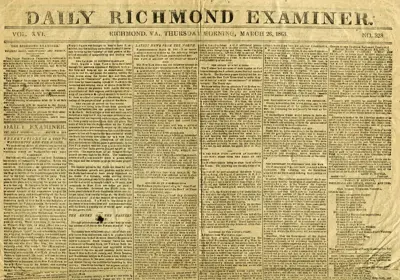
The Richmond Examiner, a newspaper which was published before and during the American Civil War under the masthead of Daily Richmond Examiner, was one of the newspapers published in the Confederate capital of Richmond. Its editors viewed strong executive leadership as a threat to the liberties of its subscription readership. The paper published staunch and increasingly vitriolic opposition to the leadership and policies of Confederate President Jefferson Davis. Historians often consult the pages of the Examiner for insights into the growing problems faced by the Davis administration and the South as they faced the increasing prospect of defeat in the Civil War.
