Ismail Serageldin Quotes
Cultural ‘authenticity’ is neither national nor exclusive. Even Picasso and Gauguin drew richly on West African influences in their most distinctive creations, reminding us of the cosmopolitan spirit that underlies dynamic modern identities.
Ismail Serageldin, Egyptian Director of the Library of Alexandria & Historian, Member of the Egyptian Senate & World Bank Enviornmental VP & World Bank Enviornmental VP & World Bank Enviornmental VP, The Challenges of Cultural Diversity, 2007
Sourced by: Eigen's Political and Historical Quotations

He was born in the Azerbaijan province of the Soviet Union and did most of his academic work in the United States. He is an example of a globalized scientist.


Egypt is one of the very few Arab nations which advocated pluralism.


His views are a mix of modernism and fundamentalism. He favors democracy and elections but also favored the Taliban destroying the great ancient Buddha statues when he was called an idol worshipper for urging the preservation of art.


The “Proms” have been traditional concerts in England for years. However, there are great differences in the musical taste and preferences of different socioeconomic and cultural subgroups. And many of these groups do not care for the type of music, the overt patriotism or the formality. The issue for England is do they change the traditional public concerts to reflect the tastes of all groups or do they fund different concerts appealing to the different cultures. The one supports unity and the other a type of separatism.


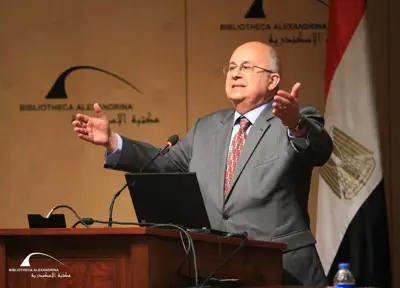
Ismail Serageldin (/ˈsɛrəɡɛldɪn/; born 1944 in Giza, Egypt), Founding Director of the Bibliotheca Alexandrina (BA), the new Library of Alexandria, inaugurated in 2002, is currently, Emeritus Librarian, and member of the Board of Trustees of the Library of Alexandria. He serves as Chair or Member of a number of advisory committees for academic, research, scientific and international institutions and civil society efforts, including as co-Chair of the Nizami Ganjavi International Center (NGIC), and serves on the Advisory Committee of the World Social Science Report for 2013 and 2016, as well as the UNESCO-supported World Water Scenarios (2013) and the executive council of the Encyclopedia of Life (2010) and Chairs the Executive Council of the World Digital Library (2010). He also co-chaired the African Union's high level panel for Biotechnology (2006) and again for Science, Technology and Innovation (STI) in 2012–2013, and was a member of the ICANN Panel for the review of the internet future (2013).
