John Kenneth Galbraith Quotes
Conventional wisdom
This appears to be the first time that this phrase has been used.
John Kenneth Galbraith, 1908–2006, Economist, U. S. Ambassador to India (Democrat), The Affluent Society, Houghton Mifflin, 1968
Sourced by: Eigen's Political and Historical Quotations


For earlier similar sentiments see Plato and William D'Avenant {312586}.


1st Baron Lytton of Knebworth


This was much more the case in 1840 when this quotation was written. Since then, a much higher proportion of American society has become educated, and the cultures that American immigrants have come from had multiplied. Publications abounded and after radio and television there were more attacks on American majority positions. The major change came with radio call in talk shows, similar TV shows and then the Internet provided a painless way to publicly go against majority opinion. By the first decade of the 21st century, movements of majority rejectionists such as the Tea Party and the Occupy Movement were thriving and “futile contests” received much public attention and showed that there were others with the non-majority views who made it socially acceptable to be outside the norms of the majority.


This appears to be the first English use of the “man in the street” expression that Ralph Waldo Emerson made more famous in his 1866 phrase: “The man in the street does not know a star in the sky.” Politicians have been using it ever since.

Statement made by Root to President Roosevelt regarding a prepared speech about the rights to build the Panama Canal.

In addition to the Attorney General, Washington’s cabinet consisted only of Thomas Jefferson, Secretary of State, and Alexander Hamilton, Secretary of the Treasury. Both were brilliant, passionate men dedicated to the new nation. However, they held opposite points of view on many major fundamental issues of political approach to the new nation. Washington greatly valued their advice and they each were magnificent administrators of their departments. However, they each distrusted each other intensely and believed that the other was advocating policies and practices that would destroy the new nation. Their squabbling was often public and Washington could never understand why they could not be civil about their disagreements. Ironically, Hamilton turned out to have been right about the assumption of state debt and the importance of business, finance and manufacturing. Jefferson whose vision had all Americans being farmers was wrong on this but was right on the limits of the executive and the rights of the individual vis a vis the government. Jefferson’s views turned out to be the ones most Americans wanted and his Democratic Republican party not only beat the Federalists but ended the Federalist Party. Hamilton died in a duel, Modern America is an amalgam of both of their views with modernity tending more and more towards Hamilton.
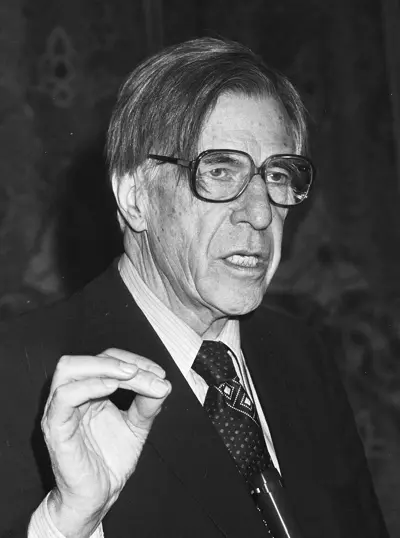
John Kenneth Galbraith OC, also known as Ken Galbraith, was a Canadian-American economist, diplomat, public official and intellectual. A leading proponent of 20th-century American liberalism, his books on economic topics were bestsellers from the 1950s through the 2000s. As an economist, he leaned toward post-Keynesian economics from an institutionalist perspective.
