Milton Friedman Quotes
Central bankers always try to avoid their last big mistake. So every time there's the threat of a contraction in the economy, they'll over stimulate the economy, by printing too much money. The result will be a rising roller coaster of inflation, with each high and low being higher than the preceding one.
Friedman, Milton, and Rose Friedman. Free to Choose: A Personal Statement. Harcourt Brace Jovanovich, 1980.


This frequent Jefferson quotation almost certainly was never written or uttered by him but was probably created by later opponents of private banks. It has never been verified from any studies of Jefferson’s prolific writings. Further the word ‘inflation” came into use in the 1860s and ‘deflation’ seems to have first been used in the 1920s. However, some ascribe it to a letter Jefferson wrote to Treasury Secretary, Albert Gallatin in 1802.


Roosevelt saw to it that the contents of the telegram was shown to the press. Then this statement was seen by the foreign delegates who viewed themselves as ‘international bankers”. They were outraged and the conference blew up with no significant action taken. Roosevelt was desperately trying to lead America out of the Great Depression which Herbert Hoover had left him with. The dollar had been falling in value since the 1929 crash and one of the likely outcomes of the conference was European and other nations putting a plan together to stop the fall of the dollar. FDR however, wanted the dollar to continue to fall. This would make it harder for Americans by buy imported products, but easier to employ more Americans making products for export. The people hurt most by The Depression did not buy any imported products, and what they needed was food, housing, clothing, education and medical care, none of which would be affected by a weaker dollar and more expensive imports. However, he did not want a political argument with the wealthy and upper middle class who wanted cheaper imports, so some people believe that he made it seem that he had committed a diplomatic blunder and that caused the conference to collapse.


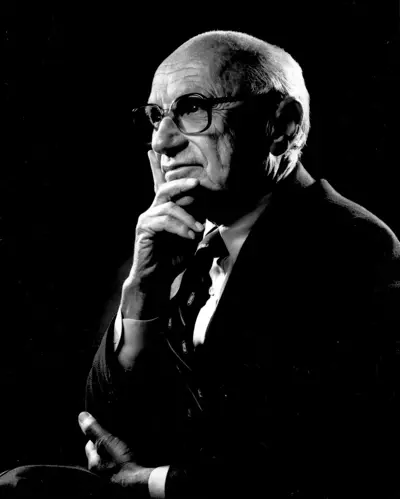
Milton Friedman was an American economist and statistician who received the 1976 Nobel Memorial Prize in Economic Sciences for his research on consumption analysis, monetary history and theory and the complexity of stabilization policy. With George Stigler and others, Friedman was among the intellectual leaders of the Chicago school of economics, a neoclassical school of economic thought associated with the work of the faculty at the University of Chicago that rejected Keynesianism in favor of monetarism until the mid-1970s, when it turned to new classical macroeconomics heavily based on the concept of rational expectations. Several students and young professors who were recruited or mentored by Friedman at Chicago went on to become leading economists, including Gary Becker, Robert Fogel, Thomas Sowell and Robert Lucas Jr.
