Desiderius Erasmus Quotes
By burning Luther's books you may rid your bookshelves of him, but you will not rid men's minds of him.
Erasmus, Desiderius. Christian Humanism and the Reformation: Selected Writings of Erasmus. Edited by John C. Olin, Fordham University Press, 1987.


The Vatican Congregation of the Index had banned Greene’s Book, The Power and the Glory. See {598544}.

Rushdie was commenting on the Danish Cartoons that had been published the year before depicting the Islamic Prophet Muhammad to the great distress of some fundamentalist Muslims some of whom orchestrated riots in many countries involving much property destruction and some loss of life. See {590918} as an example of the concern.

Vladimir Lenin


This quotation illustrates how much of an egomaniac Hitler was. Here, he had achieved almost nothing in his life very significant yet, and he compared his points to those of the founder of Protestantism when Martin Luther nailed his points to the doors of the Roman Catholic Church in Wittenberg. For a short time, they actually became more important to Germans that the points of Luther, but that didn’t last very long, and Germany has reformed itself and Luther’s points are well remembered, and Hitler’s are only studied by scholars interested in the history of the period and the Nazi era—the most tragic in German history.


In September of 2005 a Danish Newspaper published some political cartoons showing the hypocrisy of some Muslims who use Islam to justify murder of innocents and terrorism. Months later, in January of 2006 many in the Middle East protested vehemently and Muslim riots broke out because the Prophet Muhammad's visage was depicted against Islamic tradition. Many Muslim nations started a boycott against Denmark. Many Muslim leaders claimed that insulting religion was an “abuse” of freedom of speech including those from nations which regularly publish material that is virulent against Christians and Jews.


While the Visigoths had some very advanced legal principles, this law, quoted in its entirety is typical of the nations that were part of the Catholic world. The church and its doctrines were immune from any possible criticism, explicit or implicit. This is the most formalized and sophisticated compendium of laws of the so-called “barbaric peoples” of Europe. The compilation was in many ways a documentation of the traditional laws of the Visigoths that had evolved over hundreds of years.


Spinoza’s ideas were considered so radical and dangerous that he was the only man in history who was excommunicated by the Catholics, the Jews and the Muslims. This was his observation after his first excommunications -- by his Jewish Congregation in Amsterdam.


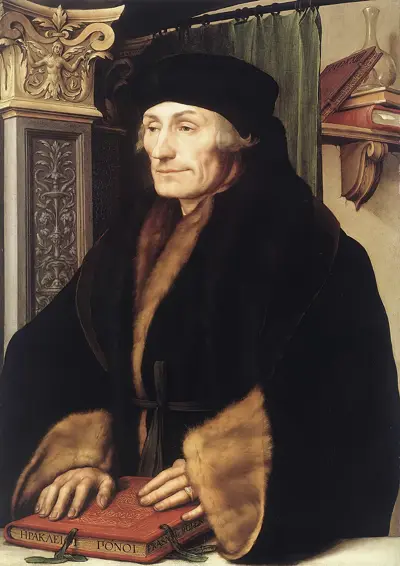
Desiderius Erasmus Roterodamus was a Dutch philosopher and Christian scholar who is widely considered to have been one of the greatest scholars of the northern Renaissance. As a Catholic priest, Erasmus was an important figure in classical scholarship who wrote in a pure Latin style. Among humanists he enjoyed the sobriquet "Prince of the Humanists", and has been called "the crowning glory of the Christian humanists". Using humanist techniques for working on texts, he prepared important new Latin and Greek editions of the New Testament, which raised questions that would be influential in the Protestant Reformation and Catholic Counter-Reformation. He also wrote On Free Will, In Praise of Folly, Handbook of a Christian Knight, On Civility in Children, Copia: Foundations of the Abundant Style, Julius Exclusus, and many other works.
