Robert M. Gates Quotes
Any time you see a straight line on a map of the Middle East, Winston Churchill probably drew it.
The British Empire Controlled Most of the Middle East in the 1920s, and they presided over most of the creations of states in the region. Churchill was a major figure in British Colonial policy. The natural borders tended to follow rivers, mountain ranges, lakes other irregular geographical elements. Borders of straight lines were almost always artificial in that men (and a few women) decided upon them as a convenience. Churchill was personally involved in much of the line drawing for borders.
Robert M. Gates, U. S. Secretary of Defense (Republican), Director of the CIA, Interview, PBS The Charlie Rose Show, May 16, 2012
Sourced by: Eigen's Political and Historical Quotations


What makes the situation even more complicated is that most of the land of the Middle East has been governed by a succession of Empires who may have drawn the lines differently from the previous governing dynasty. For example, the land that is Israel today, has been governed by Egyptians, Greeks, Jews, Romans, various Arab dynasties, Turkey, England, and the Jews again. Turkey governed it for the longest period.

The British were trying to enlist the aid of the Arabs in fighting against the Ottoman Turks who had controlled all of the Middle East in the name of Islam. There was another clause in the letter excepting the areas that Britain had agreements with France and Russia. However, unknown to the Sherif there was the Sykes-Picot treaty which had secret clauses giving Syria, Damascus and other prime areas to the French. The English could not guarantee independence to much of the Arab Mideast.


At the time, the major European countries were in a competitive scramble for colonies in Africa—so much so that there were very few independent territories left. The maps and borders of Africa were really decided by the Europeans.

At the time, Palestine was technically Turkish territory. Turkey was one of the defeated axis powers in World War I. England, as part of the World War I peace treaties, had control over Palestine as well as most of the rest of the Middle East.


Hong Kong was not always a successful city or colony. In 1844 the British were thinking of swapping it for a better colony. However, in a rare combination of synergistic development of a colony, the great strengths of the Chinese and that of the English combined to make Hong Kong one of the best and well developed cities in the world. Few imperial colonies turned out as well.

This illustrates one of the reasons that the Israeli Arab conflict has been unsolvable over the years. A thousand years ago, the Arabs were a leading intellectual and military power in the world. The rest of the world has moved ahead and they have actually retrogressed. So the Arabs seek dignity which is very elusive. They have never wanted to negotiate terms with Israel when they have been weak and feel defeated. So the pattern has been that they feel they cannot negotiate for justice as they are too week. So periodically they attack Israel which has always defeated them and hoped that after the Arab defeat, permanent negotiations for peace could take place. But the Arabs were feeling too weak. So they just repeated all their extreme demands. After a few years, they would try another attack, lose again and the cycle would repeat. The Israelis fear that if the Arabs every won a war, the Arab moderates might be willing to reasonably negotiate, the extremists would want to continue the fighting and “drive the Israelis into the sea” as they have so often threatened.


De Gaulle tended to see world affairs in terms of extreme, simplistic, and dramatic alternatives when reality is much more complex the truth was turned out to be for England a much more favorable outcome without either of these extremes.


A few months later, that is exactly what Germany did. She was hoping that England would not enter the war despite her treaty obligations, but she was willing to risk the possibility. The Czar had a strong espionage and intelligence service active in Germany, but, like so many other intelligence failures, the intelligence operatives and analysts had military and economic facts but had little understanding of the German culture which propelled Germany to what to most other cultures was “irrational policy making.” People and nations often engage in irrational activities, even against their own self-interest.


As early as 1933, 14 years before Indian independence, there was a movement for a separate Muslim nation within India. Ironically, Hindu India was never a nation in any sense of the word, but was a series of independent principalities much like Italy before its unification. However, with the Muslim conquest of the various Indian states, there was a central authority, ruler, and nation for the first time. Later the Muslims had to argue that India was not a country when it was they who had made it such. When the Muslim Emperors were in power, they argued that India was one country under their authority. But when they lost power, the Muslims argued the other side of the issue.
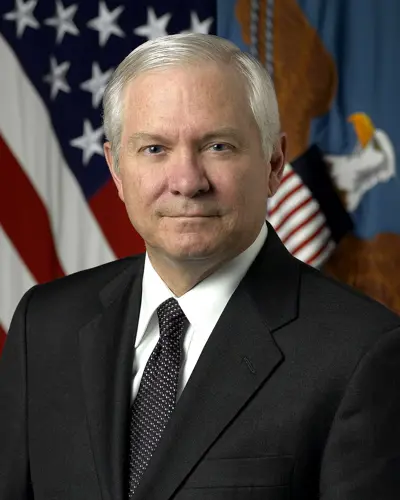
Robert Michael Gates is an American intelligence analyst, and university president who served as the 22nd United States secretary of defense from 2006 to 2011. He was originally appointed by President George W. Bush and was retained for service by President Barack Obama. Gates began his career serving as an officer in the United States Air Force but was quickly recruited by the Central Intelligence Agency (CIA). Gates served for 26 years in the CIA and the National Security Council, and was Director of Central Intelligence under President George H. W. Bush. After leaving the CIA, Gates became president of Texas A&M University and was a member of several corporate boards. Gates served as a member of the Iraq Study Group, the bipartisan commission co-chaired by James A. Baker III and Lee H. Hamilton, that studied the lessons of the Iraq War.
