Ernst Haeckel Quotes
An irrefutable proof that such single-celled primaeval animals really existed as the direct ancestors of Man, is furnished according to the fundamental law of biogeny by the fact that the human egg is nothing more than a simple cell.
Haeckel, Ernst. The History of Creation: Or the Development of the Earth and its Inhabitants by the Action of Natural Causes. Translated by E. Ray Lankester, vol. 2, D. Appleton and Company, 1876, p. 278.


This is a very good quotation showing the point of view of religious fundamentalists that if there is no fixed statement of ethics and morality as with the word of God as revealed in the Bible, what then makes anything right or wrong and the world exists in a moral behavioral vacuum. Other religionists hold that the morality is in the metaphors and philosophy of religion and not in the literal words of scripture. Still others argue that morality and religion itself is dynamic and is constantly changing. Then there are those who build their view of morality on philosophy but which is not based on a deity—Ethical Culturalists for example {592791}. Also, there are the pragmatic evolutionists who argue that cooperative behavior has evolved in man and cultural rules—morality—is also transmitted by culture and systems of law.


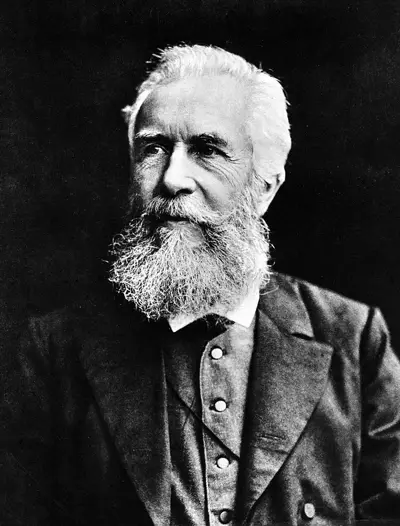
Ernst Heinrich Philipp August Haeckel (German: [ˈʔɛɐ̯nst ˈhɛkl̩]; 16 February 1834 – 9 August 1919) was a German zoologist, naturalist, eugenicist, philosopher, physician, professor, marine biologist, and artist who discovered, described and named thousands of new species, mapped a genealogical tree relating all life forms, and coined many terms in biology, including ecology, phylum, phylogeny, and Protista. Haeckel promoted and popularised Charles Darwin's work in Germany and developed the influential but no longer widely held recapitulation theory ("ontogeny recapitulates phylogeny") claiming that an individual organism's biological development, or ontogeny, parallels and summarises its species' evolutionary development, or phylogeny.
