Karl Marx Quotes
An increase in the productivity of labour means nothing more than that the same capital creates the same value with less labour, or that less labour creates the same product with more capital.
Marx, Karl. Capital: A Critique of Political Economy, Volume III. Edited by Friedrich Engels, International Publishers, 1967, p. 247.


This is a noteworthy quotation because it illustrates—to a slightly exaggerated degree—a major difference between the public and private sectors. However, Conrad fails to point out that when government does try and establish several competitive programs and approaches, conservatives like him are the first say that the government officials do not know what they are doing and then they object to the “duplication” and “waste.” Further, usually, when a government entity does experiment as the private sector competitive system does, it is chastised by liberals and conservatives alike for having had attempts that failed or did not succeed well. Experimenting requires a cultural tolerance for failure or imperfection. Only very courageous executive politicians like President Franklin Delano Roosevelt have been able to initiate many programs aiming at the same objective with the society keeping the best—like Social Security and rejecting the worst like the National Recovery Administration. See {631419} for his view.


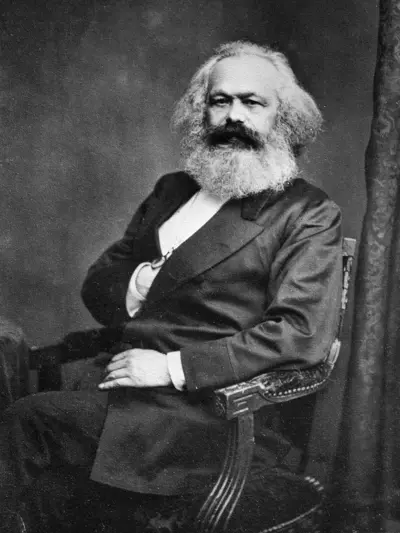
Karl Heinrich Marx was a German philosopher, economist, historian, sociologist, political theorist, journalist and socialist revolutionary. Born in Trier, Germany, Marx studied law and philosophy at university. He married Jenny von Westphalen in 1843. Due to his political publications, Marx became stateless and lived in exile with his wife and children in London for decades, where he continued to develop his thought in collaboration with German thinker Friedrich Engels and publish his writings, researching in the reading room of the British Museum. His best-known titles are the 1848 pamphlet The Communist Manifesto and the three-volume Das Kapital (1867–1883). Marx's political and philosophical thought had enormous influence on subsequent intellectual, economic and political history. His name has been used as an adjective, a noun, and a school of social theory.
