Ayn Rand Quotes
America's abundance was created not by public sacrifices to the common good, but by the productive genius of free men who pursued their own personal interests and the making of their own private fortunes.
Like many ideological political philosophers who developed a following, she tended to exaggerate many of her points and to ignore additional factors. While individual businessmen and politicians pursuing their self interests were certainly necessary for America’s great growth and success, they were not sufficient. Many of the founding fathers sacrificed their fortunes and in some cases their lives to gain American independence. And the sacrifice of millions was necessary in many conflicts were those who fought were rarely enlarging their own fortunes. And equally important factors of American success were the collective action of communities creating schools, roads, bridges, canals. The driver of the businessmen to move into critical areas was the government subsidizing the railroads, proving the telegraph useful, developing the national highway system and the Internet. Most of the great universities and research centers were created as government, charitable or religious institutions where personal profit was not a factor. It is that combination of private and public, self serving and communitarian drives, secular and religious that have created modern America. Many people in Rand’s ere did not credit the private, self serving contributions of many great men, and Rand led the movement to remind all of that critical factor. In the process of making her good point, she tended to ignore the other factors.
Ayn Rand, 1905-1982, Writer & Philosopher, Capitalism: The Unknown Deal
Sourced by: Eigen's Political and Historical Quotations


While generally true, Mises here again exaggerates his “proof” by selectively ignoring or being ignorant of counter-examples. The Roman Catholic Church is a classic counter-example where priests, monks, and others owned nothing as individuals, but produced some great science (eg Gregor Mendel), art (the illuminated texts of the middle ages), literature (St Thomas Aquinas, etc). The best counter example that was just evident in the last decade of Misis’ life is Communist Russia. Russian science was better than Fance and Germany and second only to the United States. The Russian ballet and orchestras were second to none. Great literature came out of the Soviet Union and the best of it complained about and attacked the Soviet system of the times. In general, Mises principle tended to be correct throughout history but not always as he dogmatically stated.


The implication of the investment in infrastructure and education is that the state must tax people at a rate that would pay for it. But if the rate is too high, he argues, people will not make a sufficient profit from their work.


3rd Earl Russell of Kingston. Ironically he was regarded as a socialist by most people. His view of socialism however was what evolved as European Democratic Socialism and not the “dictatorship or the proletariat” type of Communist Socialism.


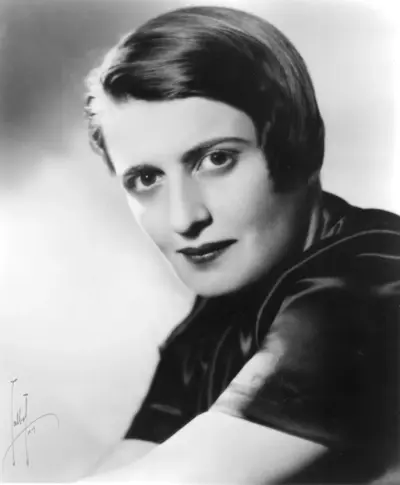
Ayn Rand was a Russian-American writer and philosopher. She is known for her two best-selling novels, The Fountainhead and Atlas Shrugged, and for developing a philosophical system she named Objectivism. Born and educated in Russia, she moved to the United States in 1926. She had a play produced on Broadway in 1935 and 1936. After two early novels that were initially unsuccessful, she achieved fame with her 1943 novel, The Fountainhead. In 1957, Rand published her best-known work, the novel Atlas Shrugged. Afterward, she turned to non-fiction to promote her philosophy, publishing her own periodicals and releasing several collections of essays until her death in 1982.
