Mark Twain Quotes
All that we require of a voter is that he shall be forked, wear pantaloons instead of petticoats, and bear a more or less humorous resemblance to the reported image of God. He need not know anything whatever; he may be wholly useless and a cumberer of the earth; he may even be known to be a consummate scoundrel. No matter. While he can steer clear of the penitentiary his vote is as weighty as the vote of a president, a bishop, a college professor, a merchant prince. We brag of our universal, unrestricted suffrage; but we are shams after all, for we restrict when we come to the women.
Samuel Langhorne Clemens, 1835-1910
Mark Twain, Writer, Founder, Anti-Imperialist League, "Universal Suffrage" speech delivered to the Monday Evening Club about 1875
Sourced by: Eigen's Political and Historical Quotations

Samuel Langhorne Clemens, 1835-1910. This is an excellent example of political sarcasm. Read literally, this quotation indicates that he was opposed to women’s suffrage, and was a fairly extreme sexist. What he was doing however, is stating publicly the argument that many men made at the time—especially those who were not highly literate or well-educated. By stating the argument of the opposition, he allows fair minded people to be exposed to views that they might otherwise not be exposed to. Many sexist men at the time read the quotation and, not appreciating Twain’s sarcasm, concluded that Twain, unlike most of the “egghead intellectuals” of the day was an opponent of the increasingly militant feminists. In actuality, Mark Twain was a strong feminist. See {630191}, {630192}, & {630193}.


The concept of taxpayers being entitled to vote to avoid taxation without representation was fundamental to the Founding Fathers. However, the only people who paid taxes were those who owned property as there was no income tax at the time. Since the male controlled the family property, not allowing women to vote did no injury to the basic principle. However, the sexist attitude of the times ran up against this basic principles in the case of widows and unmarried women who owned property. Faced with this contradiction, some of the Founding Fathers like Lee actually favored the voting franchise for women who were widows and property owners or even unmarried female property owners. There were not enough people who saw this contradiction so that all women were originally prohibited from voting, but this quotation shows that it was a political issue at the time.


The editorial was in support of women’s suffrage—the right to vote which at the time women did not have in Britain. Women were very active in protests and demonstrations. Tactics sometimes involved civil disobedience and chaining themselves to public buildings. It was the civil disobedience and disruptions that the newspaper referred to as the “follies and excesses.” In retrospect today, it is amazing how threatened the society felt and how they reacted to the “threat” of females voting. It does however give us a perspective on those contemporary societies which restrict women’s voting rights.


Hunt gave as an example Mary Smith of Stanmore. This quotation is very interesting in the history of women’s suffrage. Hunt was a strong advocate for Universal Suffrage (See {616653}.) At the time, even men had to be a taxpayer and own a sufficient amount of property to vote. Less than 20% of the population of Britain were allowed to vote. The argument at the time was that the husband would represent the family’s interest at the ballot box and there was no need for women to vote. But by facing parliament with the logical inconsistency of its position, he was able to make his point, although there were very few women like Mary Smith who were single and had the economic resources to qualify. Most widows remarried so even if they had economic resources, there was a man who could assume the then perceived role of head of the household.

The following year, women got the right to vote, the first nation to reach that level of enlightenment.

Although she was living proof of a woman’s ability to accomplish what most men could not, she was always publicly differential to men and their sexism. Although she opposed women voting in Parliamentary elections, she did believe that women should vote in local elections where the understood the issues much better.


She was then an invalid trying to recover from the toll of all her work at the front lines of wars had taken. The men she had so helped, did not return the gesture when it came to voting, She did not live to see women get the vote in America.


First female presidential candidate & first divorcee to run for that office. The half to which she was referring were the females, who by many narrow laws were unable to participate in the intellectual and political life of the country. At the time, women could not even vote.

This was more than 30 years earlier than the United States.

Howe said women should be officially deprived of the ballot because of this reason.

Although liberal on many other issues, women voting was anathema to him.


Having passed this law, the state legislature turned down subsequent efforts to expand the female voting franchise, and Wisconsin women had to wait until all American women finally got the right to vote.

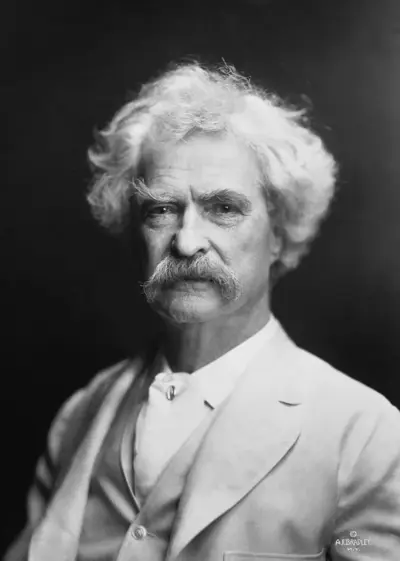
- Born: November 30, 1835
- Died: April 21, 1910
- Nationality: American
- Profession: Author
Samuel Langhorne Clemens, known by his pen name Mark Twain, was an American writer, humorist, entrepreneur, publisher, and lecturer. He was lauded as the "greatest humorist the United States has produced," and William Faulkner called him "the father of American literature". His novels include The Adventures of Tom Sawyer (1876) and its sequel, the Adventures of Huckleberry Finn (1884), the latter often called "The Great American Novel".
