George Berkeley Quotes
All our measures should tend towards the immediate encouragement of our woolen manufactures, which must be looked upon as the basis of our wealth.
In 1701 exports of wool accounted for ¼ of all exports. By 1770, it was almost 1/3.
George Berkeley, 1685-1753, Irish Bishop & Philosopher, Minister, Society for the Propagation of the Gospel in Foreign Parts, 1737
Sourced by: Eigen's Political and Historical Quotations


All money has based on the Gold Standard then. But the economic output of the American colonies was increasing rapidly. If the money supply stays fixed, there is a shortage of money and this then inhibits further growth, Franklin realized this and called for an increase in the money supply. He was only 23 years old when he wrote this essay and had these insights.


His prediction was accurate and the consequence was an increase in the production of agricultural products and a shrinking proportion of Americans employed in farming and ranching.

This is the origin of one of the first Departments of Commerce.


His government had just used force to disarm the rebellion of religious Kurds.


This quotation is interesting as it shows that and the end of the 19th century, although the United States was over 100 years old, we were first beginning to be major world traders. Not that our merchant marine was not yet world class. Another interesting facet of the quote is that the President was claiming that foreign trade was good for the domestic economy. Much of America in its first 100 years supported protectionism for American manufacturers.
The nation, under the pressure of a depression, had adopted a free trade philosophy. We would go back to protectionism in the 1930s and back to free trade in the 1960s. Ironically, it was generally the Republican party that has driven these shifts. There has always been a free trade wing of the party and an isolationist wing.


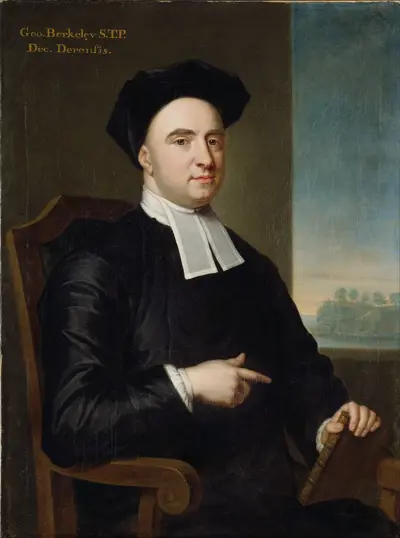
George Berkeley – known as Bishop Berkeley (Bishop of Cloyne of the Anglican Church of Ireland) – was an Anglo-Irish philosopher whose primary achievement was the advancement of a theory he called "immaterialism" (later referred to as "subjective idealism" by others). This theory denies the existence of material substance and instead contends that familiar objects like tables and chairs are ideas perceived by the minds and, as a result, cannot exist without being perceived. Berkeley is also known for his critique of abstraction, an important premise in his argument for immaterialism.
