Marie Curie Quotes
All my mind was centered on my studies, which, especially at the beginning, were difficult. In fact, I was insufficiently prepared to follow the physical science course at the Sorbonne, for, despite all my efforts, I had not succeeded in acquiring in Poland a preparation as complete as that of the French students following the same course.
Curie, Marie. Pierre Curie. Translated by Charlotte and Vernon Kellogg, The Macmillan Company, 1923, p. 168.


If we do not have more scientific graduates from the university we will lose contact with modernity.
One of his major initiatives was to reform the Italian university curriculum to have more scientific offerings. Italy historically has been a great scientific culture ranging from Galileo to Enrico Fermi, but in recent times the universities have not had strong scientific curricula.

She had just defeated the previous board chairwoman, Linda Holloway,who had voted with the majority the previous year to revise the standards so that evolution would not be included. See Linda Holloway {603677}.

The “New” system had reformed very slowly {41427} and then had been spurred by Congress passing the Morrill Act which established land grant colleges in each state provided they taught practical things as well. President Buchanan twice vetoed the act as Southern states preferred the “old” style. But in 1862 it passed again and in one of the great American reforms in the midst of the Civil War, most of our great State Universities got their starts when Lincoln signed the act.


What is interesting about this advertisement is the last line advertising that the school was coeducational. Earlham was not the first college in America to admit females—Obelin College did in 1833. However, when schools accepted females there was usually controversy and they did not advertise the fact. But here Earlham’s advertisement tells us a few things about the culture. There must have been many young women who wanted to attend college, otherwise there would not have been any point in advertising for them. In addition, although coeducation at the college level was an uncommon notion, it was probably not offensive to most people in the area lest the ads would not have been publicly run.


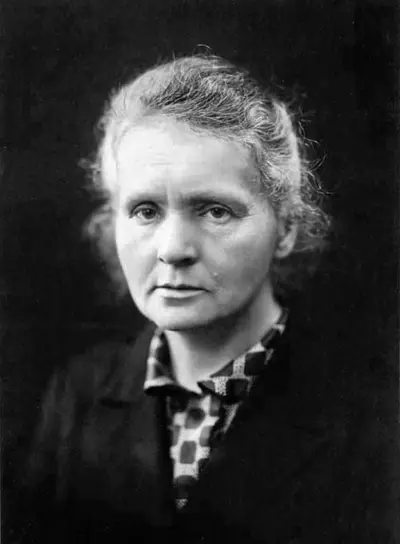
Marie Skłodowska Curie (/ˈkjʊəri/ KEWR-ee; French: [kyʁi]; Polish: [kʲiˈri]), born Maria Salomea Skłodowska, was a Polish and naturalized-French physicist and chemist who conducted pioneering research on radioactivity. As the first of the Curie family legacy of five Nobel Prizes, she was the first woman to win a Nobel Prize, the first and the only woman to win the Nobel Prize twice, and the only person to win the Nobel Prize in two scientific fields. She was the first woman to become a professor at the University of Paris in 1906.
