Roger Sherman Quotes
All civil rights and the right to hold office were to be extended to persons of any Christian denomination.
United States Continental Congress. "Instructions to the Commissioners Appointed to Go to Canada," 20 Mar. 1776. Journals of the Continental Congress, 1774-1789, Vol. 4, edited by Worthington Chauncey Ford, Government Printing Office, 1906, p. 216.


There was freedom of religion for Protestants in early New Jersey. Note that Catholics and Jews were not allowed to hold office. This constitution was in force until 1844 when the prohibition was repealed by new constitution. Under the original constitution, men were convicted for blasphemy. See {621063} .
Actually, there was no initial concern or protest. The New York Boards voted unanimously to approve th project, Then one woman started complaining to the media and there were a number of people who also opposed the construction of a Then Islamaphobic people joined the protest, Many politicians observed that in Saudi Arabia, the nation from which most of the 9-11 attackers came from, it is but the country, it is illegal to bring a Bible into tnot only illegal to build a Christian Church or Jewish Synagogue ANYWHERE in the nation while America already has thousands of Mosques, Most other Islamic countries make it difficult if not impossible for a non Muslims to build a place of worship. Bloomberg reminded Americans that there was no objection that the government Constitutionally could make to the proposed mosque. Although other nations may prohibit religious construction, America was unique in adopting our First Amendment, the Separation of Church and State, and while a number of countries since have emulated America, most nations have not reached the point where they have matured sufficiently to realize the importance of separation of church and state. The fact that other nations do not follow American fundamental political principles which our founding Americans adopted, certainly does not mean that we should emulate them and abandon that which has made America such a great country and an example to the world. Ironically, the Muslim Imam in charge of the building project.


Porush was one of the Haradi--ultra-orthodox Jews. In the land of the Jewish people, he argued against religious freedom for Jews unless they were Orthodox Jews, while ironically, the majority of Jews in the world and even in Israel followed the Conservative or Reform branches of Judaism or were secular. At the time the Orthodox Jewish movement was the only one that was recognized officially by the government. Porush and some of the more fanatical Haradi were determined to keep the Conservative and Reform Jewish branches unrecognized and unsupported by the government. (Israel does not have separation of church and state and economically supports the Orthodox Jewish establishment but not the other majority branches of Judaism.) The "Women of the Wall" is one of the major groups in Israel advocating equal government treatment for all citizens o0f Israel. Orthodox Judaism, like many other orthodox religions are very sexist and women were actually banned from praying at the holiest of Jewish places, the Western or Wailing Wall. Women of the Wall had won a major decision of the Israeli Supreme court that women could not be denied the right to pray at the Wall. The orthodox rabbis who the government allowed to control access to the Wall, set aside a small area for women at the "Dung Gate" where the garbage was carried out. Women of the Wall were back in court and this prompted Porush's outburst. He was cebsured by the Ethics Committee of the Israeli Knesset (Parliament).

Newspaper of the Association

The same phrase was used by Count de Montalembert at a Catholic conference in Malines, August 20, 1863, and is sometimes attributed to him.


Levy was the first Jewish naval captain of the United States Navy. He was acknowledged by the Secretary of the Navy to be qualified for promotion to Commodore, but there was much anti-Semitic opposition among the other senior officers. Levy was finally promoted to Commodore. He was so grateful for the freedom of America that he had purchased Thomas Jefferson's home Monticello and maintained it as a shrine to the author of the Declaration of Independence. See George Bancroft


In some countries, although not theocracies, the religious establishment had an automatic right to sit in the parliament. In this particular case it was essentially only the majority church. Catholics had 1 seat and the various protestant denominations, Jews, and others had no automatic religious representation in the legislature.
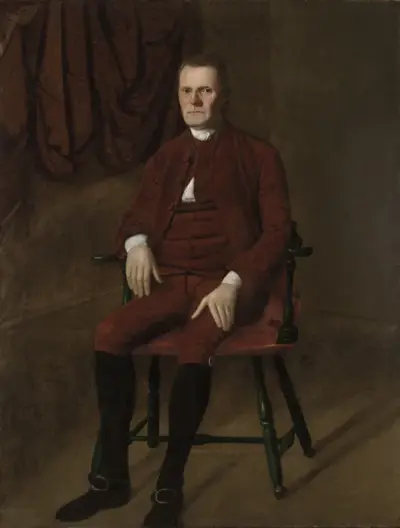
Roger Sherman was an early American statesman and lawyer, as well as a Founding Father of the United States. He is the only person to have signed all four great state papers of the United States: the Continental Association, the Declaration of Independence, the Articles of Confederation, and the Constitution.
