Carter Glass Quotes
A liberal is a man who is willing to spend somebody else's money.
Carter Glass, 1858-1946, U. S. Congressman & U. S. Senator (Democrat, VA), U. S. Secretary of the Treasury, September 24, 1938
Sourced by: Eigen's Political and Historical Quotations


This could have been sent to constituents currently. The only difference between now and then is that the parties have switched positions. In 1858 the Democrats sounded like the Republicans of modern times.


This quotation pithily summarizes a common problem in politics of describing budgets. In most years there has been a national inflation. If a new budget is, in actual dollars, the same as the previous years or a little more, but the increase is less than the inflation level, the agency will not be able to provide the same level of services as the previous year. Therefore services will be cut and those who are politically in favor of more money for the program legitimately describe this as a “budget cut”. Opponents of larger funding increases, also legitimately describe the funding as a “budget increase”. One side refers to what the money can buy and the other, to the absolute dollars spent. This is an example of the classical ambiguity of political oratory.


Actually, there have been “paranoid” fear of opposition political viewpoints in America very often. In the early days of the Republic, the Federalists main concern was not England or other foreign enemies, but Jefferson’s Democratic Republicans. And those Jeffersonians were absolutely convinced that the greatest danger to America was the Federalists who would bring back a monarchy if they could. The Jacksonians triggered a similar polarization. The Civil War stemmed from this extreme. Even America’s most popular President, Franklin Delano Roosevelt, who was elected to 4 successive terms, was perceived as the major “enemy” of America along with his wife Eleanor and the other New Dealers.
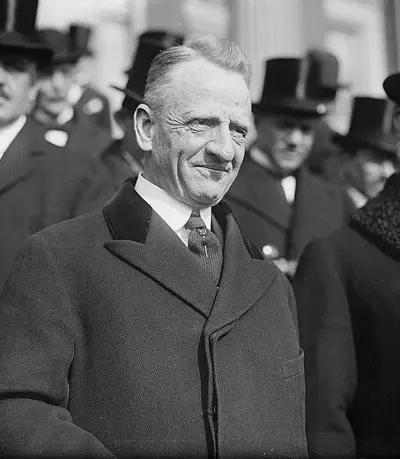
Carter Glass was an American newspaper publisher and Democratic politician from Lynchburg, Virginia. He represented Virginia in both houses of Congress and served as the United States Secretary of the Treasury under President Woodrow Wilson. He played a major role in the establishment of the U.S. financial regulatory system, helping to establish the Federal Reserve System and the Federal Deposit Insurance Corporation.
