Voltaire Quotes
A lady of honor may be raped once, but it strengthens her virtue.
Voltaire. Candide, ou l'Optimisme. Cramer, 1759, ch. 8.


This quote illustrates how ignorant some members of Congress are about basic science and human reproduction. There is absolutely no physiology whereby the trauma of rape can cause a contraceptive effect. Akin was in the midst of a Senate race, and his opponents and the press pilloried him for his ignorance. The previous year there were about 32,000 pregnancies resulting from rape in the United S tates. Worse for Akin, his use of “legitimate rape” got him into trouble with the voters also. His implication that there were some rapes that were NOT legitimate infuriated many voters. He lost the election in a state where the Republicans were predicted to win.

This proverb which actually has the force of de facto law in much of the Arab world, while detested by many sophisticated Westerners and Americans in particular, was actually a custom in America for many years. Under the principle, a rapist is not a rapist if he marries the girl. A seducer is not a seducer. In the Bedouin culture there is no difference between the rapist and the seducer. The reason that the practice is so hateful is that it assumes that when a woman is raped or seduced the damage is to the woman’s male relatives—to their honor. Therefore, the “crime” can be remedied by marrying the girl and satisfying the male relative’s sense of honor. Then no harm has been done, except of course to the woman who often becomes the double victim, first of the rape or seduction and then of a forced marriage. In modern America the honor of the male relatives has no standing in law, yet even today some judges and prosecutors will go easy on a statutory rapist or worse if he marries the girl and the girls family goes along with the arrangement. The term “shotgun wedding” stems from a time when family members would force the alternative on seducers.


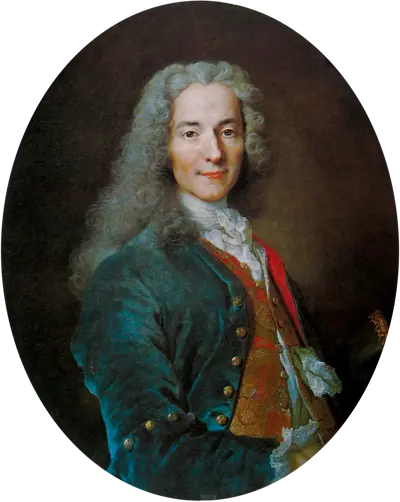
François-Marie Arouet, known by his nom de plume Voltaire (/vɒlˈtɛər, voʊl-/; also US: /vɔːl-/; French: [vɔltɛːʁ]), was a French Enlightenment writer, historian, and philosopher famous for his wit, his criticism of Christianity—especially the Roman Catholic Church—as well as his advocacy of freedom of speech, freedom of religion, and separation of church and state.
