Hannah Arendt Quotes
A conception of law which identifies what is right with the notion of what is good for—for the individual, or the family, or the people, or the largest number—becomes inevitable once the absolute and transcendent measurements of religion or the law of nature have lost their authority
Hannah Arendt, 1906-1975, Political philosopher & historian, The Origins of Totalitarianism, 1951
Sourced by: Eigen's Political and Historical Quotations


A fatwa is a religious legal ruling.

The Pope separates the church from the civil law to a degree that is a rarity amongst religions. Even Catholic Pope John Paul II who prohibited priests from holding political office always saw Papal and clerical influence on civil law making and interpretation as a fundamentally important role.


The country had been completely polarized by 1854. It was only a matter of time for something like the Civil War to break out. The impossibility of compromise was not just held by radicals like Garrison but after the Compromise of 1850 fell apart, most politicians on both sides s

He was referring to the period of the military and strongman takeovers of the Arab countries in the 2nd half of the 20th century. Intellectuals were never allowed to play any significant role.

The Diggers were a religious-economic movement that even today would be considered very radical. They advocated the right of the poor to go onto public lands and farm them—thus the name “Diggers.” Beyond their opposition to the private ownership of land to the exclusion of the poor, Winstanley and the Diggers promulgated another very modern doctrine: That the poor should take the responsibility and have the right to determinine how the society should provide for the poor. A version of this became one of the Mottos of the Poverty Program of 1964. See {616966}.


This quotation is noteworthy because he is one of the only Judeo-Christian theologians who hold that the ends justify the means. Even most politicians do not believe this.


This is a very good quotation showing the point of view of religious fundamentalists that if there is no fixed statement of ethics and morality as with the word of God as revealed in the Bible, what then makes anything right or wrong and the world exists in a moral behavioral vacuum. Other religionists hold that the morality is in the metaphors and philosophy of religion and not in the literal words of scripture. Still others argue that morality and religion itself is dynamic and is constantly changing. Then there are those who build their view of morality on philosophy but which is not based on a deity—Ethical Culturalists for example {592791}. Also, there are the pragmatic evolutionists who argue that cooperative behavior has evolved in man and cultural rules—morality—is also transmitted by culture and systems of law.


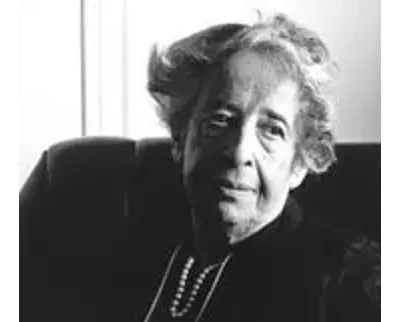
Hannah Arendt was a German-born American political theorist. Her many books and articles have had a lasting influence on political theory and philosophy. Arendt is widely considered one of the most important political thinkers of the 20th century.
