ROBERT CLIVE
(Robert Clive, 1st Baron Clive)
1st Baron Clive. Clive went to India as a military accountant and clerk of the British East India Company which had its own Army intended for protection of Company staff and property. Clive worked his way up the military and company ladder and then commanded all the British (company) troops. Under his command the Company, in the name of the British Government actually began to rule territory at first buying that right from the Indian ruler for English pounds of silver. Then Clive used the Army to deal with disorder and banditry and took over new territory where local leaders had aided those who were harassing the British. Soon, he had control of more land than the rest of Britain together with many more people. In the process, his accounting skills served him well and the British East India Company had made a fortune larger than anything in British history and Clive himself became the richest man in England. There was a famine in India and Clive and the Company did little to alleviate the suffering. They continued to make huge profits while many of the people were dying, hence the nickname. The inquiry was called to see of Clive and the Company had been escessive in their rule and had taken too much profit.
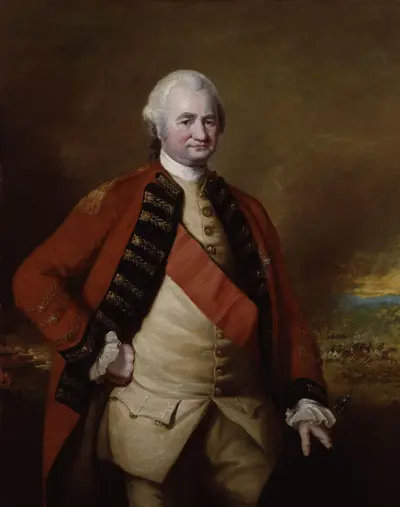
Major-General Robert Clive, 1st Baron Clive KB, FRS, also known as Clive of India, was the first British Governor of the Bengal Presidency. He is credited along with Warren Hastings for laying the foundation of the British Empire in India. He began as a writer (the term used then in India for an office clerk) for the East India Company (EIC) who established the military and political supremacy of the EIC by securing a decisive victory in Bengal and looting its treasury of an estimated £2.325 billion in modern terms. In return for supporting the Nawab of Bengal Mir Jafar on the throne, Clive was granted a jaghire of £30,000 (equivalent to £4,100,000 in 2019) per year which was the rent the EIC would otherwise pay to the Nawab for their tax farming concession, when he left India he had a fortune of £180,000 (equivalent to £24,300,000 in 2019) which he remitted through the Dutch East India Company. Blocking impending French mastery of India, and eventual British expulsion from the continent, Clive improvised a military expedition that ultimately enabled the EIC to adopt the French strategy of indirect rule via puppet government. Hired by the EIC to return a second time to India, Clive conspired to secure the company's trade interests by overthrowing the ruler of Bengal, the richest state in India. Back in England, he used his treasure from India to secure an Irish barony from the then Whig PM, Thomas Pelham-Holles, 1st Duke of Newcastle, and a seat for himself in Parliament, via Henry Herbert, 1st Earl of Powis, representing the Whigs in Shrewsbury, Shropshire (1761–1774), as he had previously in Mitchell, Cornwall (1754–1755).
