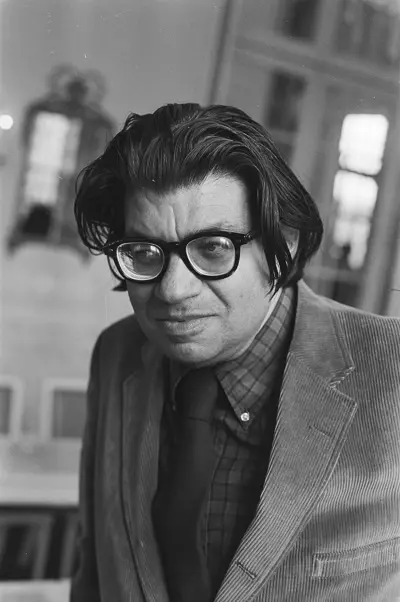
Compositionally I always wanted to be like Fred Astaire.
I'm not suspicious, I'm just careful.
For years I said if I could only find a comfortable chair I would rival Mozart.
I've been living with the minor second all my life and I finally found a way to handle it.
What was great about the 50s is that for one brief moment - maybe, say, six weeks - nobody understood art.
Boulez, who is everything I don't want art to be... Boulez, who once said in an essay that he is not interested in how a piece sounds, only how it is made.
Since music has never had a Rembrandt, we have remained nothing more than musicians.
We do not hear what we hear..., only what we remember.
At one point [Cardew] taught himself to play guitar simply in order to take part in the performance in a composition by Boulez, which is a little like saying he learned Danish to read Kiekegaard.
I was once married to a woman who could eat anything and tell you what was in it: the most complicated recipes. Her memory of taste - now that's what I call memory!
I never feel that my music is sparse or minimalist; the way fat people never really think they're fat. I certainly don't consider myself minimalist at all.
The most interesting aspect for me, composing exclusively with patterns, is that there is not one organizational procedure more advantageous than another, perhaps because no one pattern ever takes precedence over the others.
No one has the Houdini school of composition.
If you think you might have secret information listening to me, you're lost.
Music is essentially built upon primitive memory structures.
I want to give my compliments to Australia. Ever since your government paid a few million dollars for a Jackson Pollack painting, I figure that it must be a marvellous country.
For me it's the instrument. If I want to think of a flute and the state of the arts I hear a vibrato; I don't know what a flute is unless the person plays it for me.
Any professional knows that the flute and the piano is a boring combination. All you've got to arrive at is a kind of typical gestural crap, right? You might agree, though you wouldn't call it gestural crap.
Art in relation to life is nothing more than a glove turned inside out. It seems to have the same shapes and contours, but it can never be used for the same purpose. Art teaches nothing about life, just as life teaches us nothing about art.
I have a very dear friend, a great painter, called me up very upset, the work wasn’t going well… He asked me to come to his studio -- which I did -- I looked around at the work, dozens of sketches, drawings, large pictures, and I was very close to his work, intensely involved with his work, and he asked me, ‘What’s wrong?’ And I said, ‘Simple – it’s a loss of nerve.
Most music is metaphor, but Wolff is not. I am not metaphor either. Parable, maybe. Cage is sermon.
Music can imply the infinite if enough things depart from the norm far enough. Strange "abnormal" events can lead to the feeling that anything can happen, and you have a music with no boundaries.
I never understood what rules I was supposed to learn, and what rules I was supposed to break
After all, Jews invented psychiatry to help other Jews become Gentiles.
To understand what music has to be, you have to live for music. Who's ready to do that?
It appears to me that the subject of music, from Machaut to Boulez, has always been its construction. Melodies of 12-tone rows just don't happen. They must be constructed....To demonstrate any formal idea in music, whether structure or stricture, is a matter of construction, in which the methodology is the controlling metaphor of the composition...Only by 'unfixing' the elements traditionally used to construct a piece of music could the sounds exist in themselves--not as symbols, or memories which were memories of other music to begin with.
The tragedy of music is that it begins with perfection.
Morton Feldman was an American composer.