I don't think words always lead to meaning, but the things you can create with them are still pretty amazing. I've been really into Joni Mitchell, for example, but I've also been into some studio stuff, like Bjork.
I call myself a singer-songwriter influenced by the gospel and jazz tradition. Naturally, because of my lifestyle and love for nature, there's a lot of folk and Americana there because that's just my life.
The whole musical institution of the church involves a lot of different styles of communication at the same time. Things like call and response. Sometimes they use the music to pray and work things out. And there's so much repetition in gospel, it's like churning butter.
Gardening is a working meditation for me. It helps me remember process, and it helps me remember patience.
I'd been trained in choral, gospel, and a little bit of opera.
Everyone I perform and tour with looks out for each other; we ensure we stay healthy.
As I grow older, I hope I can fully embody my grandmother's remarkable peace.
Singing in church is a very different approach to music. It's very much about transcending the idea of self. It's about finding something greater that connects all of us. Gospel music is about tapping into that.
I'm a preacher's kid, I'm big-boned, I have giant feet, and I've always been able to run fast, and so I had this sense of, 'I can't fail. I'm invincible. I'm made of green juice and concrete; nothing's gonna happen to me.'
What I like is not a particular genre, it's storytelling. There's a lot of great storytelling in jazz, and in folk and in country music.
I am more prolific when I have something to respond to. I get my juice from people and real stories and things that seem common but are amazing.
I think of myself as an interpretative singer and a songwriter.
There's a lot of pressure that comes from the mainstream stuff, and already people who have been saying - people who don't know any better - have been saying things to me like, 'You should really think about neosoul. You'd definitely be more successful in that.' But that's not my expression.
I'm in love with the way that Ella Fitzgerald delivered a lyric. She would deliver a lyric with the kind of clarity that would make you wonder why it was written, and make you think about the writer. I think every writer hopes an Ella of any genre or anytime gets a hold of their work and works the song like that.
There's a beautiful, kind of seductive trap in being autobiographical in our writing of songs: We just get stuck in our own syrup, and it's so personal that it almost can be embarrassing to the listener.
It's very hard for me to place myself alongside another artist. Everyone has something unique to express.
Surrender is working with what happens.
Whoever is playing with me, they participate in the arrangement; I learned from Craig Street to really pool the stories and the skill and the voices of everybody around you on the bandstand to build an arrangement in the moment.
I studied opera for a year at Georgia State University, but I wasn't interested in that meticulous, technical approach to music. So I left school and went back to jazz.
I love talking to other musicians on tour and finding out what we all have to do, not just as artists but as business people. A lot of us are investing and trying to use social media. It is such an interesting level of responsibility and engagement on all these levels. I don't know how one can do this without absolute commitment and faith.
I'm a real Otis Redding fan, and I just think he sounds so good. He sounds like he's always at the end of a long day, and he just won't give up. I just love his wearied devotion - that beautiful, beautiful, weathered sound.
'Moffou' is one of my favorite records.
My mom has a couple great tricks, but my father is consistently a good cook. He's extremely avid about health and fitness and a bit obsessive. He always talks about garden-fresh food.
I think living in a way that's close to nature makes you feel like that - makes you feel how thin the veil is between life and death.
I know how to make myself comfortable.
I want to record, tour, and just live life.
I come from a family that has grown their own food from well into times of slavery, provided for themselves and people around them. So I found, through conversations about the earth and about the house with my neighbors, a lot of common ground.
I've begun to realize, as I'm getting older, that I was taught to go for a certain kind of stillness to get things done. I missed that in my life. I loved my grandmother's property, out in South Georgia right above the Florida line, so I just thought I'd find some property where I could feel that again.
Making a record and being a touring artist is about cooperation between spirit, craft, emotion, and focus.
If we work on it, we can absolutely refuse any notion that suggests that after generations of contributing to this country, being a part of the bones and the marrow, that I'm supposed to be uncomfortable here.
'Salt' is like this snapshot in midair, an action shot. It's about my relationship with the church, the classical and choral music that I dealt with in school, and my new introduction to jazz. It's very hard for me to listen to from beginning to end, because I hear how lost I was.
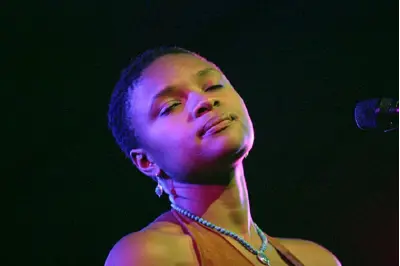
Elizabeth LaCharla Wright is an American jazz and gospel singer.