KONDIARONK
To many Indian tribes, the authority structure of the French and English monarchist societies with their Governors and other officials connoted a lack of freedom. Other Indian tribes were more authoritarian than the English or French.
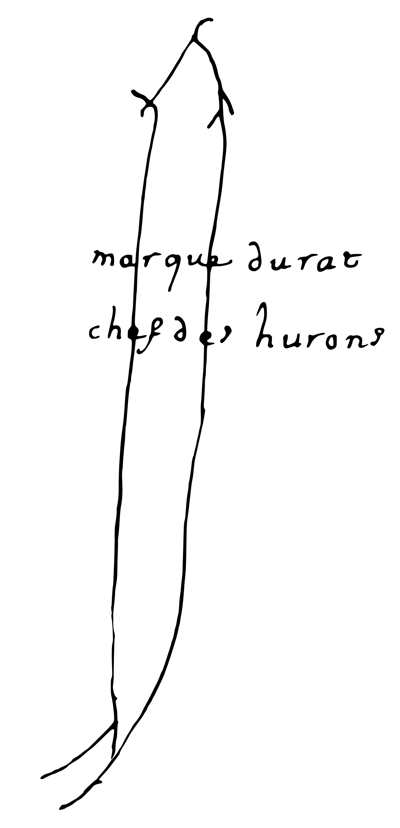
Kondiaronk (c. 1649–1701) (Gaspar Soiaga, Souojas, Sastaretsi), known as Le Rat (The Rat) was Chief of the Hurons at Michilimackinac. As a result of an Iroquois attack and dispersal of the Hurons in 1649, the Hurons settled in Michilimackinac. The Michilimackinac area refers to the strait between Lakes Huron and Michigan (or, the area between Michigan's Upper and Lower Peninsulas). Noted as a brilliant orator and a formidable strategist, he led the pro-French Petun and Huron refugees of Michilimackinac against their traditional Iroquois enemies. Kondiaronk realized the only way to establish security was to maintain a war between their enemies, the Iroquois, and the French in an attempt to keep the Iroquois occupied and the Hurons safe from annihilation. Kondiaronk succeeded in killing the peace; however, once he had secured the preservation of his people he favored a vast peace settlement. This effort concluded in what is known as The Great Peace of Montreal (1701) between France, the Iroquois, and the other Indian tribes of the Upper Great Lakes. This ended the Beaver Wars and helped open up the interior of North America to deeper French exploration and commerce. Kondiaronk made them see the advantages such a peace would bring them. The Jesuit historian, Father Pierre François Xavier de Charlevoix wrote that "it was the general opinion that no Indian had ever possessed greater merit, a finer mind, more valor, prudence or discernment in understanding those with whom he had to deal". Louis-Hector de Callièr, the Onontio (governor) that replaced Frontenac, was "exclusively indebted to him for...this assemblage, till then unexampled of so many nations for a general peace". Kondiaronk contracted a fever and died in Montreal during the negotiations for the Great Peace on August 2, 1701. A Christian convert, his body was buried at Montreal's Notre Dame Church after a majestic funeral. No trace of the grave remains. The Kondiaronk Belvedere in Montreal's Mount Royal Park is named in his honor. In 2001 he was named a Person of National Historic Significance by the Canadian government.
