Raj Chetty Quotes
You’re twice as likely to realize the American Dream if you’re growing up in Canada rather than the U.S.
The American Dream is the reasonable possiblity of upward mobility, and at the time of this statement, a person growing up in Canada had twice the chance of an American of Achieving that.
Raj Chetty, WNYC, Freakonomics Radio, 2017
Sourced by: Eigen's Political and Historical Quotations


This principle has been referred to as The Great Gatsby Curve. See {630975}.


After the Meltdown of 2008 at the end of the George W. Bush administration, the Great Recession shut many of the traditional American opportunities, and even in 2013 when this quotation was written opportunities for the poor were much fewer than at most other times in American history.

Of all the inequalities that existed in society, the easiest one to overcome with effort is wealth. Race, blood, parentage, even education are not as easily overcome. Of all the inequalities, traditionally Americans have been least offended by that of wealth under the theory that with current effort that can often be overcome. It is only in the latter part of the 20th century where modern economics and sociology have shown that wealth inequality itself is also difficult to overcome, that money as a societal leveler has been conceptually diminished. Sedgwick was the first American to identify the phenomenon that had operated in early America.

Finland at the time also had the characteristics generally associated with the American Dream: Freedom, equality, opportunity, high standard of living, educational opportunity, and social mobility. Milliband’s message was that while the United States was the first country to reach this high standard, there have recently been a few other nations that also provided that wonderful set of experiences and opportunities—specifically some of the Nordic countries where the gap between rich and poor was smaller than the U. S.
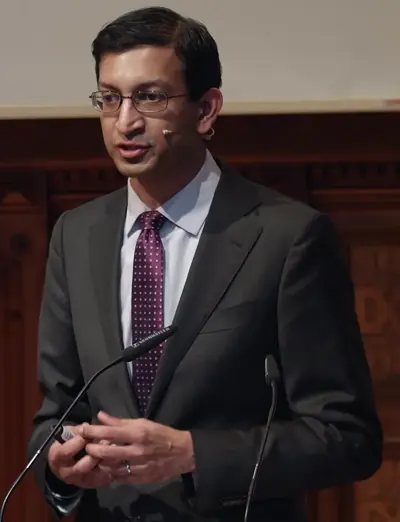
- Born: August 4, 1979
- Nationality: American
- Profession: Economics
Nadarajan "Raj" Chetty (born August 4, 1979) is an American economist. He is a professor of economics at Stanford University, specializing in the field of public economics.[2] Some of Chetty's recent papers have studied equality of opportunity in the United States[3] and the long-term impact of teachers on students' performance.[4] Chetty previously taught at Harvard University, where he was offered tenure at the age of 28 and accepted at 29, becoming one of the youngest tenured faculty in the history of Harvard's economics department. He is a recipient of the John Bates Clark Medal and a 2012 MacArthur Fellow.[5] Currently, he is also an advisory editor of the Journal of Public Economics
