Desiderius Erasmus Quotes
You'll see certain Pythagorean whose belief in communism of property goes to such lengths that they pick up anything lying about unguarded, and make off with it without a qualm of conscience as if it had come to them by law.
Erasmus, Desiderius. Praise of Folly and Letter to Martin Dorp 1515. Translated by Betty Radice, Penguin Books, 1971, p. 165.


50 years later a similar phrase was made famous be anarchist Pierre Joseph Proudhon.

Essentially, this was the law in much of the United States until the last century when the concept of sufficient force replaced any deadly force. There are still some Americans who prefer the Visigothic law to our more modern one. This is the most formalized and sophisticated compendium of laws of the so-called “barbaric peoples” of Europe. The compilation was in many ways a documentation of the traditional laws of the Visigoths that had evolved over hundreds of years.


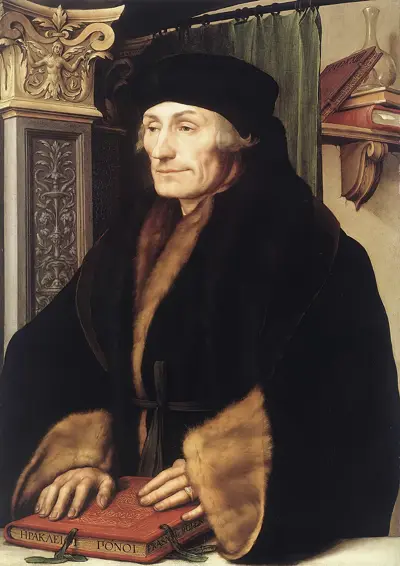
Desiderius Erasmus Roterodamus was a Dutch philosopher and Christian scholar who is widely considered to have been one of the greatest scholars of the northern Renaissance. As a Catholic priest, Erasmus was an important figure in classical scholarship who wrote in a pure Latin style. Among humanists he enjoyed the sobriquet "Prince of the Humanists", and has been called "the crowning glory of the Christian humanists". Using humanist techniques for working on texts, he prepared important new Latin and Greek editions of the New Testament, which raised questions that would be influential in the Protestant Reformation and Catholic Counter-Reformation. He also wrote On Free Will, In Praise of Folly, Handbook of a Christian Knight, On Civility in Children, Copia: Foundations of the Abundant Style, Julius Exclusus, and many other works.
