Ernest Hemingway Quotes
You love a lot of things if you live around them, but there isn't any woman and there isn't any horse, nor any before nor any after, that is as lovely as a great airplane.
Hemingway, Ernest. "London Fights the Robots." Collier's, 19 Aug. 1944.


Two years later he flew. That is how fast and dramatic the Wright Brothers work had gone. Once they got on the right track, everything began to fall into place. Two years earlier he had been optimistic. See {613170}.


Cayley developed the first gliders and envisioned air travel at the same time that Thomas Jefferson was President.

Ataturk quickly envisioned the importance of the airplane. He even sent is daughter to Russia to learn to fly a plane, and she became the first Turkish Military Officer to do so. This was typical of Ataturk—killing two or more reform “birds” with one stone. He not only brought the airplane into the Turkish consciousness by having his daughter fly which attracted great attention of the press and got people talking, but showed that women were capable of the most complex technological tasks. Before Ataturk, few women in Turkey ever did anything but parenting and homemaking. Ataturk gave Turkish women the vote before America adopted women’s suffrage.


It is perhaps ironic that Langley had the vision of air flight while Wilber Wright, the inventor of the first airplane a few years later, saw it’s role much more limited. See: {42182}.


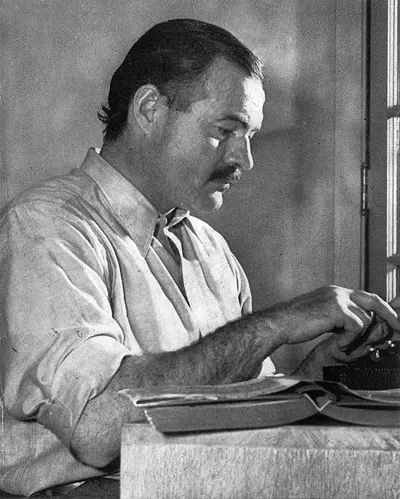
Ernest Miller Hemingway was an American novelist, short-story writer, journalist, and sportsman. His economical and understated style—which he termed the iceberg theory—had a strong influence on 20th-century fiction, while his adventurous lifestyle and his public image brought him admiration from later generations. Hemingway produced most of his work between the mid-1920s and the mid-1950s, and he was awarded the Nobel Prize in Literature in 1954. He published seven novels, six short-story collections, and two nonfiction works. Three of his novels, four short-story collections, and three nonfiction works were published posthumously. Many of his works are considered classics of American literature.
