John Quincy Adams Quotes
Women are not only justified, but exhibit the most exalted virtue, when they do depart from the domestic circle, and enter upon the concerns of their country, of humanity and of their God.
John Quincy Adams, 1767-1848, 6th President of the United States (Independent, MA), Speech, House of Representatives, 1838
Sourced by: Eigen's Political and Historical Quotations


The Prophet of Islam was not as sexist and discriminatory against women as are many of his modern followers. The women voting to which Terabi referred took place over 1000 years before Christians and Jews allowed women to vote. Unfortunately, Islam went from a modern, open, intellectual, tolerant, innovative religion, to just the opposite.

She was instrumental in outlawing slavery and two years after this speech she and her daughters appeared in public without the traditional Burka or veils. The conservative fundamentalists were outraged and they deposed her husband and her modern influence ended.


The following year, women got the right to vote, the first nation to reach that level of enlightenment.

Her husband had been assassinated. It is not uncommon that after a political assassination, the widow of the slain male politician, carries on the political legacy. But otherwise there are few female politicians in the Third World in general and the Middle East in particular. Arab and other cultures so severely restrict a woman’s mobility within the society that death of a husband or father seems to be the only vehicle whereby a woman enters politics.


Although she was living proof of a woman’s ability to accomplish what most men could not, she was always publicly differential to men and their sexism. Although she opposed women voting in Parliamentary elections, she did believe that women should vote in local elections where the understood the issues much better.


that women do not want to vote At the turn of the century, it was considered perfectly reasonable for men to write and speak about what women wanted. Some women actually felt the way Abbot described as they had never been exposed to any other alternatives. However, the very fact that Abbott felt compelled to write this article in one of America’s leading publications tells us that there was a substantial number of women who wanted the vote and who were being very active in demanding same. And once women got the vote, they have tended to vote in higher proportion to the men. So Lyman was proved wrong by events. The notion that women valued their maternal and homemaker roles to the exclusion of voting, working and otherwise participating in society, happened to fit in well with a religious world view that a minority of American Christians believe even today is the mandate of God.


The Bible and the Church have been the greatest stumbling blocks in the way of women’s emancipation.
The most important documents and doctrine of most churches were created by men who also established the framework of the religion. The result has in almost all cases been a sexist structure with women having not only little power not typically females are banned from all church governance. See {640303} for her quote on religion in general vis a vis women.

In one of the earliest claims that women should be allowed to preach, she made a theological argument and then challenged the male theologians to better her arguments. Although she was very demur, intellectually and theologically she “took it right at them.” Such intellectual aggression by women was virtually unheard of.
The Bahai religion is one of the few whose doctrine is not sexist and advocates gender equality


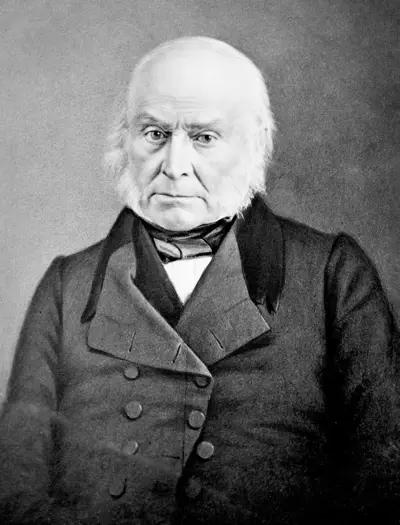
John Quincy Adams was an American statesman, diplomat, lawyer, and diarist who served as the sixth president of the United States, from 1825 to 1829. He previously served as the eighth United States Secretary of State from 1817 to 1825. During his long diplomatic and political career, Adams also served as an ambassador, and as a member of the United States Senate and House of Representatives representing Massachusetts. He was the eldest son of John Adams, who served as the second U.S. president from 1797 to 1801, and First Lady Abigail Adams. Initially a Federalist like his father, he won election to the presidency as a member of the Democratic-Republican Party, and in the mid-1830s became affiliated with the Whig Party.
