Constance Baker Motley Quotes
When Thurgood Marshall became a lawyer, race relations in the United States were particularly bad.
Motley, Constance Baker. Equal Justice Under Law: An Autobiography. Farrar, Straus and Giroux, 1998.

The statement was made even more dramatic as the outgoing Governor, Lester Mattox, standing behind Carter at the ceremony, was an arch segregationist.

Reconstruction was the period in the South after the Civil War. The change that emancipation brought to the white South was traumatic, and there was a constant struggle between those who wanted the Blacks to be integrated into Southern Society—and those Southerners who wanted to create a society that would be as close to slavery as possible, So the Klu Klux Klan and other terrorist organizations formed and with lynching and other intimidation, much of the initial progress of Reconstruction was rolled back and did not get reinstated until the Civil Rights and Voting Rights Acts were passed in 1964.

In the 1930s African Americans who traveled were subject to countless humiliations whenever the sought hotels, rooming houses, restaurants and other accommodations. Gas stations would not allow them to use bathrooms and they were reduced to using open fields. Traveling and vacationing was, for Blacks, humiliating. Wikipedia: “Green reviewed hotels and restaurants that did business with African Americans during the time of Jim Crow laws and racial segregation in the United States. He printed 15,000 copies each year. In the 1930s, Green began his work by compiling data on stores in the New York area that accepted black travelers, and published his first guide in 1936. Similar guides had been published for Jewish travelers, who sometimes faced discrimination. Green's guide was so popular that he immediately began to expand its coverage the next year to other US destinations, adding hotel and restaurants as well.”


This was art of the Nixon "Southern Strategy" to alienate the white supremacists and racists from the Democratic Party with Civil Rights legislation and rhetoric, and get most of them to become Republicans. But as Phillips observed, when Negroes began voting in significant numbers in the South the party switching really accelerated.


Justice Marshall, in he early career played an extremely important role in the development of the law vis a vis race and discrimination in America. He went from town to town in the Jim Crow, segregated South filing and often winning civil rights lawsuits. This was an era where lynching was still prevalent, and he was often threatened with bodily harm or death. Justice Ginsberg who also had been a leader in filing and winning civil rights suits but she worked in the area of women’s rights. The host had stated that she and Marshall were the great legal pioneers in civil rights litigation. Ginsberg explained that she hers was a much easier role and Marshall should receive much more credit. This was her reason.


Vladimir Lenin. In their quest for world revolution, the Russian Communists had more problems with arguments in the United States whose reforms and economy had produced a very high standard of living. They knew that to effect a revolution, they had to reach the middle class and the intellectuals. They had little economically to attack America with but they were able to attack the United States morally. Even though segregation was legal in America at that time, many Americans thought it immoral. Most of the rest of the world did also. So that was one of the attack points. Since the communists opposed U. S. racial segregation, many Southern segregationists used a perverted logic and accused everyone who opposed segregation of being a communist. In addition to racial segregation, the Communists attacked other forms of discrimination such as anti-Catholic, anti-Asian, and anti-Semitic (See {638737} ) behavior.


The all white regular Mississippi Delegation was selected in elections where Blacks were barred from voting although Blacks were in the majority in Mississippi. In addition, the regular party was advocating obstructing the Supreme Court school integration decisions and the Civil Rights Act that had just been passed. See {637616}. The insurgent group was selected in integrated elections, contained black and white delegates, and was pledged to support and obey the laws. The President could not make the decision unilaterally, but had a great deal of influence.


Preclearance was a requirement that any change in the voting or registration laws, rules or procedures needed to be approved by the Federal Justice Department. He was testifying about why preclearance was important and why it was placed in the Voting Rights Act every time it was reauthorized. See {635271} for what happens without preclearance.

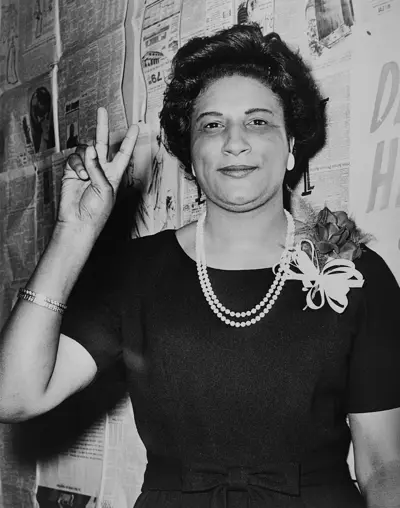
Constance Baker Motley, was a key strategist of the civil rights movement, lawyer, judge, state senator, and Borough President of Manhattan, New York City. She obtained a role with the NAACP Legal Defense and Educational Fund before entering law school as a staff attorney and continued her work with the organization for more than twenty years. She argued 12 landmark civil rights cases in front of the Supreme Court, winning nine. She was a law clerk to Thurgood Marshall, aiding him in the case Brown v. Board of Education. Baker Motley was also the first African-American woman appointed to the federal judiciary, serving as a United States District Judge of the United States District Court for the Southern District of New York. Judge Motley died on September 28, 2005 in New York City of congestive heart failure.
