John Keats Quotes
What occasions the greater part of the world's quarrels? Simply this: Two minds meet and do not understand each other in time enough to prevent any shock of surprise at the conduct of either party.
Keats, John. Letter to Benjamin Bailey, 22 Nov. 1817. The Letters of John Keats: 1814-1821, edited by Hyder Edward Rollins, vol. 1, Harvard University Press, 1958, p. 188.


Tesla was one of the great American immigrant scientists. He found in America the kind of intellectual and operational freedom that did not exist in the rigid, monarch-controlled, Austro-Hungarian Empire. He developed patents and techniques that formed the technological bases of radio, telephone long distance, TV, cell phones, Wi Fi, just to name a few. Most important he was Thomas Edison’s great nemesis. Edison invented DC electric generators that could power factories or entire streets in a neighborhood. Tesler invented and developed AC electrical technology which could power entire cities and he could move electricity over long distances which Edison could not. Tesler was one of the first scientists to conceive of and try to implement “Big Science” where there were huge capital investments to develop machines and systems to do what had never been done before—philosophically like the CERN Hadron Collider. Tesler even convinced a large corporation to finance the construction of a massive building and tower so he could experiment with the wireless transmission of electricity. However, as the industrial democracies have learned, Big Science can only be funded by governments and it often takes sever working in consort to afford the huge investment that is required. In Tesler’s era, the federal and state governments did not fund scientific research so his work was not only technically ahead of his time but also conceptually. He anticipated most of the problems and need for a national power grid that was challenging America even at the beginning of the 21st century.


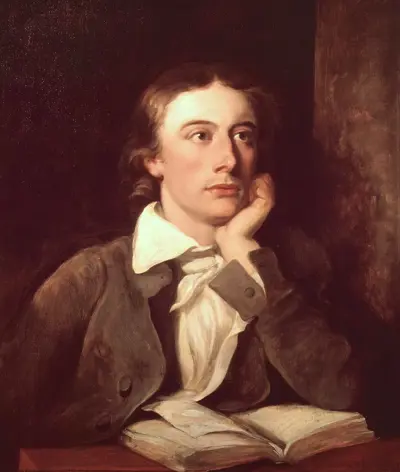
John Keats was an English Romantic poet. He was prominent in the second generation of Romantic poets, with Lord Byron and Percy Bysshe Shelley, though his poems were in publication for only four years before he died of tuberculosis at the age of 25. They were not generally well received by critics in his lifetime, but his fame grew after his death, and by the end of the century he had become one of the best beloved English poets, with a strong influence on many writers. Jorge Luis Borges called his first encounter with Keats' work an experience that he felt all of his life. It had a style "heavily loaded with sensualities", notably in the series of odes. It was typical of the Romantics to accentuate extreme emotion through emphasis on natural imagery. Today his poems and letters remain among the most popular and analysed in English literature. Especially acclaimed are "Ode to a Nightingale", "Sleep and Poetry" and the famous sonnet "On First Looking into Chapman's Homer".
