Richard P. Feynman Quotes
What is the fundamental hypothesis of science, the fundamental philosophy? We stated it in the first chapter: the sole test of the validity of any idea is experiment. ... If we are told that the same experiment will always produce the same result, that is all very well, but if when we try it, it does not, then it does not. We just have to take what we see, and then formulate all the rest of our ideas in terms of our actual experience.
Feynman, Richard P., Robert B. Leighton, and Matthew Sands. The Feynman Lectures on Physics, Volume I: Mainly Mechanics, Radiation, and Heat. Addison-Wesley, 1963, p. 2-1.


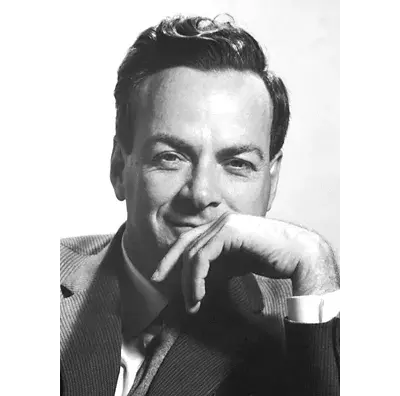
Richard Phillips Feynman was an American theoretical physicist and Nobel Prize winner who made significant contributions to quantum mechanics, quantum electrodynamics, and particle physics. He's known for his work on the Manhattan Project, developing Feynman diagrams, and explaining the interactions between light and matter. While studying for his PhD, Feynman participated in the Manhattan Project and helped develop the atomic bomb. For contributions to the development of quantum electrodynamics, Feynman received the Nobel Prize in Physics in 1965 jointly with Julian Schwinger and Shin'ichirō Tomonaga.
