Irene Joliot-Curie Quotes
We have shown that it is possible to create a radioactivity characterized by the emission of positive or negative electrons in boron and magnesium by bombardment with alpha rays.
Joliot-Curie, Irène. "Artificial Production of Radioactive Elements." Nobel Lectures, Chemistry 1922-1941, Elsevier Publishing Company, 1966, pp. 366-368.


This is one of the most momentous quotations of all time. Otto Hahn was a German Chemist who until recently had worked with Lisa Meitner in one of the most productive scientific collaborations of all time. However, Meitner was Jewish and had to flee from Germany with Hahn’s help for her life. She went to Stockholm where they were doing almost no nuclear research and although she was a famous physicist, there was no laboratory or university that could use her talents, thus her term “empty handed”. She and Hahn had conducted a series of experiments bombarding radioactive material with particles which transmuted the radioactive element to another element nearby on the Periodic Table of the elements—an element with a close atomic number. After Meitner escaped, Hahn with Fritz Strassmann assisting, bombarded uranium the heaviest element with neutrons, the heaviest particles. However, in addition to the expected results, a substantial amount of Barium remained after the bombardment. Hahn was a brilliant experimental chemist and at first he assumed that perhaps they had identified the Barium erroneously or the data was read incorrectly, or the experiment had been contaminated. There was no explanation for it. So he sent copies of all the data to Meitner a brilliant Physicist and Mathematician who was the theoretician of their team. She studied the data with her nephew, Otto Frisch who was a young up and coming mathematician. After a few days, she had figured it out. Hahn had produced the first human induced case of nuclear fission although they gave it that name a little later. She and her nephew confirmed all the data readings mathematically and proved exactly what had happened. She refers to it in the letter as “splitting” the atom. She wrote to Hahn and explained what had happened. Without any intention of doing so, he and Strassmann were the first scientists to create a real example of nuclear fission. The world has never been the same since. Hahn and Strassmann were awarded the Nobel Prize.


This was the first description of Radioactive Decay.
Meitner and her nephew Frisch had been the first people to realize that the atom had been split. Meitner had described the process to her nephew and he made some drawings of the process she described. A few of these looked like a bacteria dividing. Frisch happened to meet with William A. Arnold, an American Biologist doing research in Stockholm. He asked Arnold what the biologists called it when a bacteria divided, and he replied, “fission”. Frisch told his aunt and she decided that they should use that term in the scientific article they were preparing on the splitting of the atom.


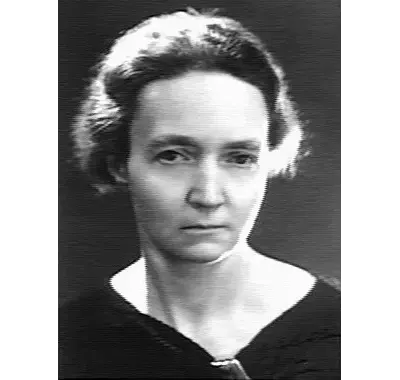
Irène Joliot-Curie was a French chemist, physicist, and a politician of partly Polish ancestry, the elder daughter of Marie Curie and Pierre Curie, and the wife of Frédéric Joliot-Curie. Jointly with her husband, Joliot-Curie was awarded the Nobel Prize in Chemistry in 1935 for their discovery of artificial radioactivity. This made the Curies the family with the most Nobel laureates to date. She was also one of the first three women to be a member of a French government, becoming undersecretary for Scientific Research under the Popular Front in 1936. Both children of the Joliot-Curies, Hélène and Pierre, are also prominent scientists.
