Milton Friedman Quotes
We economists don't know much, but we do know how to create a shortage. If you want to create a shortage of tomatoes, for example, just pass a law that retailers can't sell tomatoes for more than two cents per pound. Instantly you'll have a tomato shortage. It's the same with oil or gas.
Friedman, Milton, and Rose Friedman. Free to Choose: A Personal Statement. Harcourt Brace Jovanovich, 1980.

Hoover was the Food Administrator at that time. Although he gave lip service to the free market economy concept, he was proposing government price controls and rationing. When the free market was not functioning, at this time in his career, he was willing to use government controls and regulation. By the end of 1918 over 250,000 food-handling corporations, firms, and individuals were under Food Administration licenses. Meat, fish, poultry, eggs, butter, milk, potatoes, fresh and dried vegetables, and fruits, canned goods, the coarse grains and rice, vegetable oils, coffee, and such various commodities accessory to food-handling, as ice, ammonia (for ice-making), arsenic (for insecticides), jute bags, sisal, etc., were under direct control. Ironically, later when he was President and faced with the Great Depression, he had become much more rigid and would not “interfere” with the free, private market and use government to solve the national problems. It was Franklin Delano Roosevelt who did that after Hoover would not. At the time he gave this speech, Hoover was not very political and was more of a technocrat. It may have been that by the time he became President he was intellectually and politically locked in to Republican Party conservative economic ideology.


Brandeis was U. S. Supreme Court Justice Louis D. Brandeis, 1856-1941, who wrote that competition would control prices if only healthy competition could be maintained—the problem was resolved by both increasing competition and much more stringent regulation of corporations.


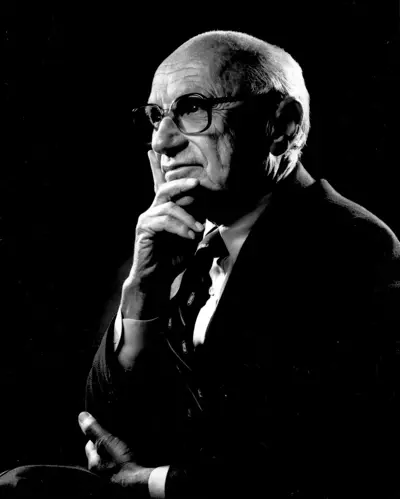
Milton Friedman was an American economist and statistician who received the 1976 Nobel Memorial Prize in Economic Sciences for his research on consumption analysis, monetary history and theory and the complexity of stabilization policy. With George Stigler and others, Friedman was among the intellectual leaders of the Chicago school of economics, a neoclassical school of economic thought associated with the work of the faculty at the University of Chicago that rejected Keynesianism in favor of monetarism until the mid-1970s, when it turned to new classical macroeconomics heavily based on the concept of rational expectations. Several students and young professors who were recruited or mentored by Friedman at Chicago went on to become leading economists, including Gary Becker, Robert Fogel, Thomas Sowell and Robert Lucas Jr.
