Condoleezza Rice Quotes
We are much safer in the United States, but not yet safe.
Condoleeza Rice, National Security Advisor (Republican), Comment on the War on Terrorism, Interview, NBC Meet the Press, March 14, 2004
Sourced by: Eigen's Political and Historical Quotations

The Bush administration were busy making their appointments and setting some domestic priorities. In 4 months 9-11 would make them wish that they had taken these warnings more seriously. See {637530}.


The bipartisan Presidential Commission had unanimously made 41 recommendations to prevent future terrorist attacks. While the Bush Administration and Congress implemented a few many of the more critical ones were left unaddressed. The commission on its final day issued a report card giving failing grades to both the White House and the Republican-controlled Congress.

He was the first American that who was assassinated by the Central Intelligence Agency by means of a drone attack. He was a major recruiter for Al Qaeda and he preached to 3 of the 9-11 terrorists.


The largest refinery also in Houston did not have a single armed guard on duty.

This was a realistic assessment of the power of aircraft carrier-based warplanes as had been demonstrated at Pearl Harbor.
Arguing for deploying American Homeland Security Personnel in foreign countries He was at the time Assistant Secretary of Homeland Security.

They are supplemented by contractor building guards and security officers who have minimal training, no law enforcement authority.

He was advocating ethnic profiling in the War on Terror.


This quotation is one of the few honest answers that government politicians give to questions about the effectiveness of prevention. All prevention whether it is to reduce terrorist attacks, fatal crashes on out highways, illicit drug usage or anything else, have two major problems in terms of communicating effectiveness. First, it is impossible to accurately measure what did not happen. Second, whereas prevention failures have real people and faces of the victims can be identified, it is impossible to identify the specific benefits of prevention. We know who died in the Boston Marathon bombing, but we do not know exactly who was saved by the prevention of a planned terrorist attack that was thwarted in New York. Even when the government does know that a terrorist attack was thwarted, it is rarely a good idea to make that information public as then the tourists will learn details of how a particular planned attack went awry, whereas if the government is silent, they have much less information and cannot easily adjust their strategy and tactics.


Bush claimed he did not remember the conversation. His incoming National Security Advisor, Condoleezza Rice, was also briefed about bin Laden by the Clinton anti-terrorism director, Richard Clarke. The Bush Administration ignored the warnings until bin Laden struck on 9-11

Early in the Donald Trump Presidency, some of his first decisions, including his Anti-Muslim ban on immigration and vistitation from 7 Islamic nations, were very distrubing to amy politicians experienced in national security and defense. 100 leaders from past adminsitrations, Democratic and Republicans, signed a petition warning that the travek ban endangered our national security. Then 1000 U. S. State Department Diplomats signed a letter advising the President to recind the order for similar reasons. Malinowski was asked if this kind of opposition to a new presidents actions was unusual. This quotation was his reply. Not the use of sarcasim. He states what happened in very stark terms and then says that it is not unusual and there is notjing to worry about, when it was withotu precedent ever and very worrisome to him and others. Quotations using sarcasim are very problimatical becasue just a literal reading, would lead us to believe he was not concened with sich a common occurance.

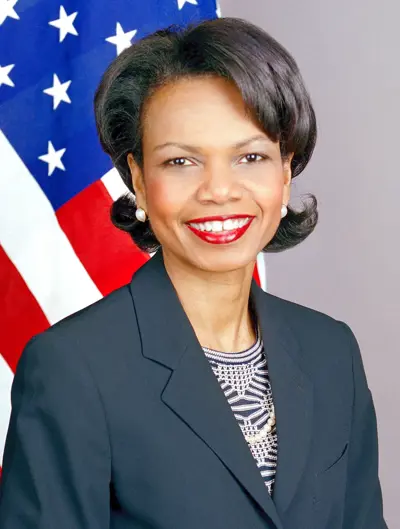
Condoleezza "Condi" Rice is an American diplomat, political scientist, civil servant, and professor who is the current director of the Hoover Institution at Stanford University. Rice served as the 66th United States Secretary of State from 2005 to 2009 and as the 20th United States National Security Advisor from 2001 to 2005. A member of the Republican Party, Rice was the first female African-American secretary of state and the first woman to serve as National Security Advisor. Until the election of Barack Obama as president in 2008, Rice and her predecessor, Colin Powell, were the highest-ranking African Americans in the history of the federal executive branch (by virtue of the secretary of state standing fourth in the presidential line of succession).
