Orhan Pamuk Quotes
Turkey was never colonized by the Western powers and consequently Turks do not have the resentment of the West that other Moslem nations have.
Orhan Pamuk, Turkish Novelist, Interview, PBS, Diane Rehm Show, October 7, 2004
Sourced by: Eigen's Political and Historical Quotations

The Arabs have a long history of arrogant and disdainful treatment by others given the British Colonial history in the Middle East, the French (who invaded Egypt under Napoleon), the Islamic Ottoman Empire which controlled the Middle East before that, and others. Along with the arrogance that usually comes with empire, Western support of the only democracy and modern state in the Middle East—Israel—was even more resented by the Arabs. Historically, there was a general feeling by much of the world that if the Arabs had no oil, no one would pay much attention to them. The Arabs naturally resented these attitudes. It was not until Nasser’s successor, Anwar Sedat, came to government in Egypt and King Hussein reformed Jordan, that Western attitudes began to change towards the Arab nations. The Western change was not because of any Arab “lesson” but the result of new, exceptionally capable leaders who have been reforming the Arab nations.


an old term for Muslims The Muslims were present in every state if India. Jinnah’s concept of nationhood is very Islamic in that Muslims are united even if they be in different states of nations. He was arguing to reserve some states as Muslim states by designation. 7 years later he would insist on a separate homeland. India was partitioned and Pakistan and Bangladesh resulted but at a fearful cost of tens of millions of lives.

A very passionate minority of India’s Muslims demanded a separate Islamic State (what would become Pakistan) but Hindu’s and Muslims were mixed throughout India and many Indians and British were concerned that there would be a bloodbath if the plans for independence went forward. Gandhi desperately tried to avoid violence but thought that independence was so important that the sectarian violence should not be an excuse for continued British rule. Unfortunately, millions of Indians were killed in the riots and ethnic cleansing and revenge that followed independence. Since then there has been much second guessing on how else the situation might have been handled.


When the Turks defeated the Christians, the only explanation many Christians could conceive of was that God was on the side of the Turks.

In 1925 his administration had passed a law banning the wearing of the traditional Muslim hat.


The Turks had massacred the vast majority of their Armenian population, and treated the Greeks badly killing and them many of them from territories the Ottoman Turks had conquered. Jews fared better but were 2nd class citizens. Bristol was the American State Department’s senior official and was very “understanding” of the murders and ethnic cleansing despite the fact that President Wilson and most American politicians were very opposed to the Turkish massacres. See {620614} and {620599} . Two factors makes this quotation very significant. First, at the time the State Department was not really under the control of either the President or the Congress. It was not rare for the Department to have its own policies and implement them. This began to change in WWII and FDR exercised much more control than previous presidents since Theodore Roosevelt. The second factor is that there were many racists throughout the State Department—Bristol was only one. There was little concern for minorities’ welfare and the emphasis was on commerce. See {620600} Even in Truman’s administration, the President had massive opposition from the State Department for his policy of recognizing the State of Israel. Today, this kind of racism in the State Department is very rare, and human rights has been one of their major concerns. There were many changes in 75 years.

This quotation illustrated the extreme polarization between the current fundamentalist Muslims, and the Muslim modernists and the West. Kamal Ataturk, the great leader and stateman who is the father of modern Turkey, is castigated by the author for leading the new Turkish parliament to depose the Caliph – the civil and religious autocrat, one of whom reigned from after the death of Muhammad till his abolishment in 1924. Most of the rest of the world credits Ataturk with being one of the great leaders of all time—one who led a democratic revolution which transformed Turkey into the only Muslim secular democracy, requiring pubic secular European type education for all children, giving women the right to vote (before the U. S. even), adopting a European alphabet and dress, and outlook on life—creating most remarkably a total cultural revolution with virtually no loss of life. No revolutionary leader, before or since has led so extensive a political and cultural revolution, and it was a bloodless revolution. Turkey, into the 21st century, was by far the most powerful, industrialized, scientific and modern nation of Muslims in the world and others were far behind. Yet many Islamic theologian still castigate Atatork for his great achievements as being against the will of God.

Greece had always coveted Anatolia which was a part of the Ottoman Empire but had been in antiquity a Greek dominated area. Further, people of Greek ethnicity and culture, who hundreds of years ago use to be the vast majority were after the hundreds of years of Ottoman rule and migration were then the largest minority in Anatolia. After the Turks lost the First World War as a consequence of their allying with Germany, and had been stripped of its Arab territories and was determined to keep the territories that they still had. Also, Turkey had just undergone a revolution and the old order was displaced. Venizelos and the Greeks saw this as an opportunity to get back Anatolia and sent a military invasion force to land at Smyrna (Ismir to the Turks), the largest city of Anatolia where despite the Greek minority in all of Anatolia, Greeks were a small majority in Smyrna and many of the ethnic Greeks not only aided the Greeks once they had landed but participated in atrocities against the minority of Turkish Muslims of Smyrna. The Ambassador was then trying to rationalize the heavy hand with which the Turks dealt with the indigenous Greeks many of whom were guilty and many of whom were not.


The Byzantine emissary had pointed out that Mehmed’s predecessors had signed a treaty agreeing to “consult” with Constantinople before building any fortified structure in the area surrounding Constantinople. Mehmed was only 19 years old at this time. His intention f building a fort was to have a platform from which to attack and capture Constantinople itself which he did 2 years later. Earlier, the Eastern Roman Empire was much stronger and the Ottoman sultans were more cautious in dealing with them. However, the various Christian factions were all feuding with each other, and Mehmed II, despite his youth, was much better organized and was a better leader than his predecessors.

This quotation illustrates that the Muslim conquest and attempt to destroy and desecrate the symbols of other religions was not limited to Christianity—it was ALL other religions. In that sense, Christianity and Islam of the period were very similar at the time—intolerance to the point of murder and destruction of any “heathen” religion.
There are other religious groups that also fear modern secular invasion, so they tend to wall themselves off as do the Amish or have their own schools as many Catholics do. However, the Muslims believe that the danger calls for a jihad and the killing and intimidation of those who advocate, create, defend or spread the secularism. Notice also that Al-Qaradhawi refers to Communism as having destroyed “Muslim countries in Asia and Eurupe.” Many countries of Europe and Asia were fought over by Christians and Ottoman Turks with one side or the other gaining control, only to be displaced by the other in subsequent years. Fundamentalist Muslims therefore think of Albania, Yugoslavia, Crimea, Croatia, and Azerbaijan, for example as Islamic countries because at one point in history they were controlled by a Muslim empire. But that was years ago. When they were invaded by the Russians, Christians, Jews, Muslims, atheists all suffered and not a single country was then controlled by Islam.

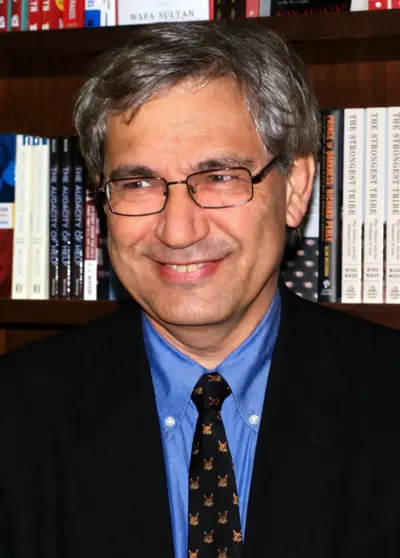
Ferit Orhan Pamuk is a Turkish novelist, screenwriter, academic and recipient of the 2006 Nobel Prize in Literature. One of Turkey's most prominent novelists, his work has sold over thirteen million books in sixty-three languages, making him the country's best-selling writer.
