Ruhollah Khomeini Quotes
Those who say that we want nationality, they are standing against Islam....We have no use for the nationalists. Moslems are useful for us. Islam is against nationality.
Khomeini, Ruhollah. Speech to the Nation, May 1981. Sahifeh-ye Imam, vol. 14, The Institute for Compilation and Publication of Imam Khomeini's Works, 2001.


English Muslim terrorist organization. This quotation illustrates what is perhaps the greatest difference between Muslims and most members of other religions. Most others think of their personal identity in national terms and then occupational, religious and racial. A Christian might say ‘I am a French Attorney who is a Christian’; a Buddhist , ‘I am a Cambodian Buddhist. But most Muslims would say, ’I am a Muslim from France’ or a ‘Follower of Islam residing in Lebanon.


Some Muslims refer to Christians as polytheists because of the concept of the Trinity. To them this is worshipping more thn one God. The Roman Catholic practice of praying to the Virgin Mary is another exmple for them.
The last clause refers to his belief that since the Prophet did not sanction or endorse nationalism, it is not desirable. It illustrates one of the difficulties the political rulers of Saudi Arabia have in defining themselves and their nation amidst a religious movement that not only transcends nationalism but sees it as undesirable and anti-Muslim. This view is not held by many more modern Muslim leaders.

This sura has been in great controversy throughout the Muslim Empires. In part it separates many of the Arab cultures from the Ottomans. The latter had an organized meritocracy whereby Jews, Christians and other “heathens” of exceptional talent were sought out for advisory and leadership positions. In part this was justified as requiring that the Caliph and the Sultans had the power of life and death over their key appointees, hence they had to be slaves and other suras prohibited Muslims holding other Muslims in slavery. Even in modern times some Muslim countries have had key non-Islamic appointees and others would not. In historical practice, the Ottoman Empire utilized far more Christians and Jews that those societies involved Muslims until relatively recent historical times.

an old term for Muslims The Muslims were present in every state if India. Jinnah’s concept of nationhood is very Islamic in that Muslims are united even if they be in different states of nations. He was arguing to reserve some states as Muslim states by designation. 7 years later he would insist on a separate homeland. India was partitioned and Pakistan and Bangladesh resulted but at a fearful cost of tens of millions of lives.

One of the noteworthy aspects of this quote is a fundamental intellectual clash. Al-Quaeda and other Islamic fundamentalists are genuinely very concerned that the West will interfere with their religion and their desire to unite all the Muslims in the world. Ironically, the West prides itself on the tolerance of religion and the freedom for anyone to practice any religion. The West does not see where it is interfering at all with the Muslim religion or its moral precepts. The problem lies in the different perception of ideas. Since about 1100 there has been a closing of Islamic intellectual growth and change. Any idea which is contrary to the orthodox view of Islam is perceived as hurtful or at least dangerous to the Muslim. Individuals in the West question Islamic relation no more than different sects of Christianity, Judaism and other religions. Allowing freedom is not sufficient for this Islamic notion; there must be no exposure to different ideas or examples. For us, no exposure means no freedom. While there are many Muslims which agree with this position, there are also many who disagree completely and believe that Islam is strengthened by exposing Muslims to all the ideas in the world. He was killed by an American air strike that had targeted him.


This was a remarkable public statement for its time. No other political leader of an Islamic country would dare claim that people have a right to be atheists. Very few would even suggest that people should be free to choose their own religion.

In World War II, all the Chinese political organizations united to fight the Japanese invaders. The Communists however did most of the fighting and took the heaviest casualties. He proposed turning on their weakened allies and that was accepted by Chiang Kai-shek, the Nationalist leader. They attacked the Communists under Mao and Cho En Lai and forced them to flee across the country in the “Long March”. The Nationalists and their warlords were hated by the majority of the Chinese, especially the peasants who provided help and support to the Communists while they made their escape. They then regrouped and attacked the Nationalists in the Chinese Revolution and this time Chiang Kai-shek, Bai Chongxi and the other Chinese Leaders fled. With few people to help them, they had to flee to Taiwan, and the Communists took over China. Some historians believe that it was Chiang Kai-shek’s strategy all along to hold his soldiers back and let the Communists bear the casualties with the intention of turning on then when the Japanese were expelled. Others claim that Chiang’s relatively unaggressive military action against the Japanese reflected his typical conservatism and avoidance of risk and there was no intention to attack the Communists after the war and the alliance was made in good faith. Note that the leading Muslims in China (where they are a significant minority) were allied with the Chinese Christians against the Communists. Bai Chongxi had a special Muslim newspaper which regularly published religious quoted from the Koran and the Hadith purporting to support and justify Chiang Kai-shek, a Christian, as the rightful leader of China. This was another example of Islam being hijacked for a narrow political purpose. Also, note his use of the word “bandits”. This is a huge insult in the Chinese language culture. So of course the Nationalists used it to refer to the Communists—See {613286} .

Most Muslims in the world prefer a Western modern lifestyle to their traditional culture. The Islamic fundamentalist leaders however see evil and the dissolution of their traditions in this process of modernization and try and polarize their communities to intimidate the modernists. The same thing happened in Christianity over the last centuries and the modernists prevailed, but even in America there are still religious fundamentalists (Christians and Jews) who reject and oppose modernism. The difference is that in America, the anti-modernists are relatively few and not nationally influential on public officials while in many Islamic nations, they are numerous and very influential on public officials. The American religious fundamentalists have already lost in trying to stave off modernity; in many Islamic nations the contest is still in doubt.

For most Muslims, their religious identity supersedes their nationalistic identity. Sukarno’s quotation is famous because many ultraorthodox Muslims castigated him for putting nationalism before Islam. There is an orthodox Islamic concept of the Ulma—the community of all Muslims in the world, and this takes precedence over any nation or set of nations. In that sense, extreme Islamic fundamentalists have always opposed Sukarno claiming he was an enemy of Islam.


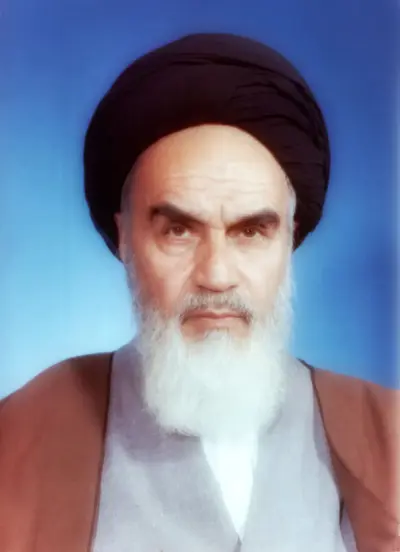
Sayyid Ruhollah Musavi Khomeini, also known in the Western world as Ayatollah Khomeini, was an Iranian political and religious leader. He was the founder of the Islamic Republic of Iran and the leader of the 1979 Iranian Revolution, which saw the overthrow of the last Shah of Iran, Mohammad Reza Pahlavi, and the end of the 2,500-year-old Persian monarchy. Following the revolution, Khomeini became the country's Supreme Leader, a position created in the constitution of the Islamic Republic as the highest-ranking political and religious authority of the nation, which he held until his death. Most of his reign was taken up by the Iran–Iraq War of 1980–1988. He was succeeded by Ali Khamenei on 4 June 1989.
