John Dee Quotes
Therefore, the central point which we see in the centre of the hieroglyphic Monad produces the Earth , round which the Sun , the Moon , and the other planets follow their respective paths. The Sun has the supreme dignity , and we represent him by a circle having a visible centre.
Dee, John. The Hieroglyphic Monad. Translated by J. W. Hamilton-Jones, John M. Watkins, 1947, p. 12.


While critics of Islam cite this sura to show how absurd the Koran can be and contradicts what is known about the Earth’s orbit, few sophisticated, moderate Muslims believe this. However, even in the United States there are many Christians and Orthodox Jews who not only deny Evolution but also believe the Earth is 6000 years old. The basic difference is that in Islamic countries publicly critiquing such anti-scientific theological statements is rare and an individual who publicly argues against the Koran taken literally is often in danger from state or private retribution. In the West the conflict between the Bible and known science is not only publicly commented upon but in a somewhat derisive way. However, consider this: Islam is about 1500 years old. When Christianity was the same age, Galileo was tried and convicted by the Catholic Church for denying this very statement. Perhaps in another 700 years Muslims will look back with embarrassment on this as most of Christianity does.

Greece claims him as well since the Greek culture was dominant throughout the Mediterranean at the time. While he was wrong about light being able to completely circle the earth, note that his view of the Earth is spherical. Most thinkers had rejected the flat earth even 400 years before Christ. It was the Church that solidified the flat earth concept.


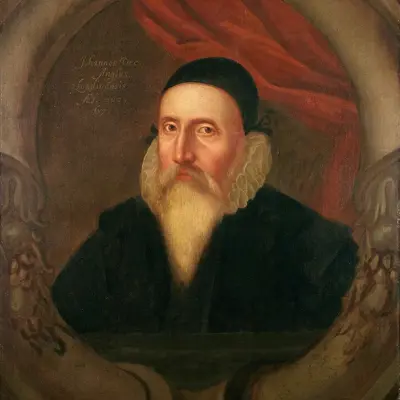
John Dee was an Anglo-Welsh mathematician, astronomer, astrologer, teacher, occultist, and alchemist. He was the court astronomer for, and advisor to, Elizabeth I, and spent much of his time on alchemy, divination and Hermetic philosophy. As an antiquarian, he had one of the largest libraries in England at the time. As a political advisor, he advocated for the founding of English colonies in the New World to form a "British Empire", a term he is credited with coining.
