Alfred, Lord Tennyson Quotes
There sinks the nebulous star we call the sun.
Tennyson, Alfred. The Princess: A Medley, Edward Moxon, 1847.


Greece claims him as well since the Greek culture was dominant throughout the Mediterranean at the time. While he was wrong about light being able to completely circle the earth, note that his view of the Earth is spherical. Most thinkers had rejected the flat earth even 400 years before Christ. It was the Church that solidified the flat earth concept.

The Roman Catholic Church had stultified scientific thinking for over a thousand years where differing with accepted church doctrine was not only discouraged but was dangerous. Hicletas—see {590328}—realized that the earth rotated around its own axis three centuries before Christ, and his view was in the literature to which learned people had access. Copernicus later communicated this idea to the Pope but in much more delicate terms—see {590327}. He did not have the problems that Galileo endured with the Church for several reasons. There were different men controlling the church, the printing press had been invented and Galileo published a book that many could read, the Protestant Reformation had really frightened the Church fathers who felt more vulnerable and less tolerant.


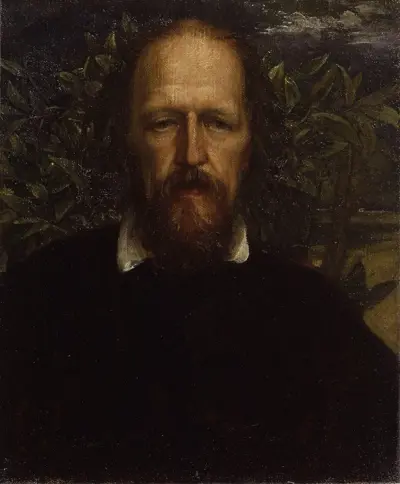
Alfred Tennyson, 1st Baron Tennyson FRS was a British poet. He was the Poet Laureate during much of Queen Victoria's reign and remains one of the most popular British poets. In 1829, Tennyson was awarded the Chancellor's Gold Medal at Cambridge for one of his first pieces, "Timbuktu". He published his first solo collection of poems, Poems Chiefly Lyrical in 1830. "Claribel" and "Mariana", which remain some of Tennyson's most celebrated poems, were included in this volume. Although decried by some critics as overly sentimental, his verse soon proved popular and brought Tennyson to the attention of well-known writers of the day, including Samuel Taylor Coleridge. Tennyson's early poetry, with its medievalism and powerful visual imagery, was a major influence on the Pre-Raphaelite Brotherhood.
