David Deutsch Quotes
The whole [scientific] process resembles biological evolution. A problem is like an ecological niche, and a theory is like a gene or a species which is being tested for viability in that niche.
Deutsch, David. The Fabric of Reality: The Science of Parallel Universes - and Its Implications. Penguin Books, 1997, p. 63.


This particular quotation is particularly distressful to some religious fundamentalists who not only will not accept that man evolved, but find it worse to accept that man is continuously evolving.

The Pope went on to state that Evolution was consistent with Roman Catholic doctrine, changing a position that had been taken by the Catholic Church and many fundamental protestant denominations. A few actually still reject evolution even after all the evidence and proof of the basic Darwinian theses. There is nothing in evolution that per se denies the existence of God or even that God created the universe and the mechanism of evolution. That is why the Catholic Church and so many Protestant Churches, Judaism, Buddhists, and so many other religions have no theological problem with evolution. Those religious groups who have difficulty with evolution are those fundamentalists (Protestants, Jewish and Muslims) who believe in the literal truth of Holy Scripture. They also assume that God designed each particular plant or animal species. Other religions hold that it was God who created the mechanism of evolution and that is how all the species developed and are developing today. Some religious evolutionists believe that evolution is God’s mechanism for perfecting man.


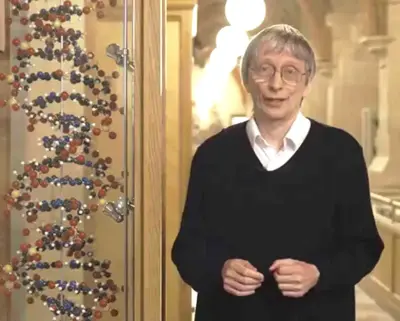
David Elieser Deutsch FRS is a British physicist at the University of Oxford. He is a Visiting Professor in the Department of Atomic and Laser Physics at the Centre for Quantum Computation (CQC) in the Clarendon Laboratory of the University of Oxford. He pioneered the field of quantum computation by formulating a description for a quantum Turing machine, as well as specifying an algorithm designed to run on a quantum computer. He has also proposed the use of entangled states and Bell's theorem for quantum key distribution and is a proponent of the many-worlds interpretation of quantum mechanics.
